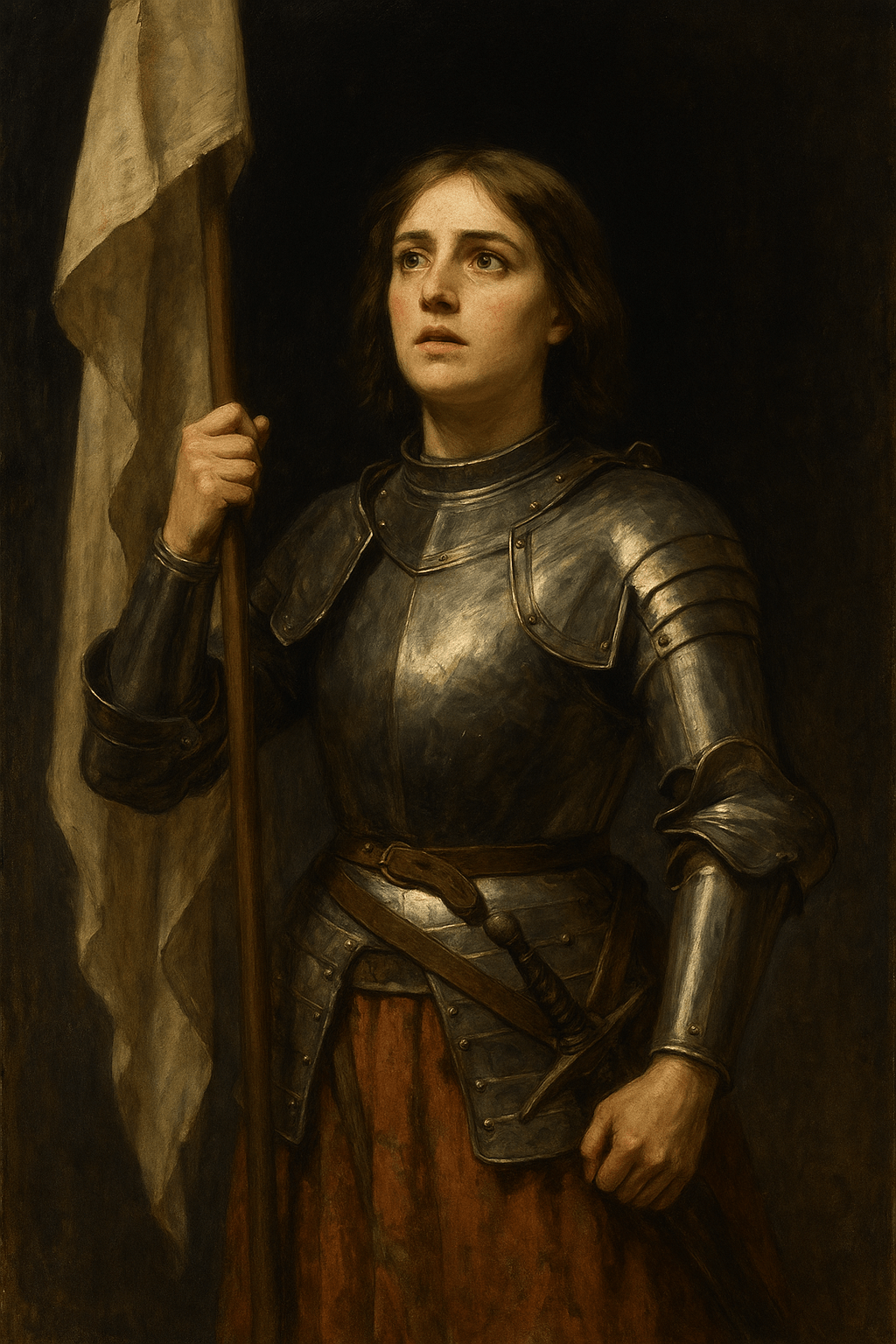
Joan of Arc, known in French as Jeanne d’Arc and often called la Pucelle d’Orléans (“the Maid of Orléans”), is one of the most iconic and contested figures in Western history. A peasant girl born in 1412 in Domrémy, Joan claimed to receive divine visions instructing her to support Charles VII and lead French forces against English occupation during the Hundred Years’ War. At just seventeen, she inspired and led troops to lift the siege of Orléans, altering the course of the war. Captured by the Burgundians, sold to the English, and tried by an ecclesiastical court, she was condemned as a heretic and burned at the stake in 1431 at the age of nineteen. Her trial records survive and bear witness to a young woman of extraordinary clarity, courage, and conviction. In 1456, she was posthumously exonerated; in 1920, she was canonised a saint by the Catholic Church.
Yet Joan’s legacy has been repeatedly rewritten, not only by official institutions, but by playwrights, poets, and political powers. One of the most enduring and damaging literary portrayals is found in William Shakespeare’s Henry VI, Part 1. Written in the 1590s, the play casts Joan, referred to only as la Pucelle, as a scheming, sexually promiscuous witch who consorts with demons and lies to save herself. The text reflects the xenophobic and misogynistic biases of Tudor England, portraying the French heroine not as a visionary leader but as an enemy caricature. It is a depiction entirely divorced from the historical Joan, but it has shaped cultural memory for centuries.
The monologue that follows is a poetic reimagining, a reversal of roles in which Joan is no longer the accused, but the prosecutor. Drawing on her documented words from her 1431 trial, the piece positions Joan as a fierce and lucid advocate for her own truth. Shakespeare, summoned now as defendant, stands accused of literary falsehood. The monologue adopts the elevated register and rhetorical style of a Shakespearean summation, but in French, the language in which Joan lived, spoke, and was silenced. Through this imagined tribunal, the piece seeks to reclaim la Pucelle not as a symbol shaped by others, but as a voice that endures, resists, and speaks still.
Jeanne contre le Barde
(Monologue final de la Pucelle au procès de la vérité)

Messieurs les juges, âmes du monde et voix non étouffées,
Écoutez-moi. Je suis celle que l’on brûla sans silence.
Non pas cendre, mais braise. Non pas spectre, mais serment.
La Pucelle, oui - mais de mon propre feu nommée.
Me voici, vivante en vérité, morte en mensonge,
Et c’est lui, ce faiseur de rois, ce brodeur de calomnies,
Que j’appelle aujourd’hui à répondre de ses vers.

Il m’a peinte sorcière, courtisane, menteuse,
M’a vêtue de péché quand j’étais cuirassée de foi.
« La Pucelle », disait-il - mais avec ricanement de plume,
Non avec la révérence due à l’innocence bafouée.
Il m’a donné aux diables que je n’ai jamais nommés,
A des lits que je n’ai jamais touchés,
A des mots que je n’ai jamais dits,
Alors que mes paroles, claires comme l’eau de Domrémy,
Étaient : « Dieu m’a envoyée. »

Ce William, ce chantre d’Angleterre,
Il ne m’a point vue. Il ne m’a point lue.
Il n’a lu que ses peurs et les a peintes en moi.
Il a fait de moi un masque pour son théâtre,
Une femme trop forte pour être vraie,
Alors il m’a brisée dans sa fiction.

Et pourtant - écoutez, car ceci est preuve -
Moi, Jeanne, devant mes juges d’hier, j’ai dit :
« Il plaît à Dieu que je sois vêtue en homme. »
Et j’ai dit : « Je m’en rapporte à Dieu. »
Et encore : « Je sais que mes voix viennent de Lui. »
Ces mots sont miens. Gravés non en parchemin,
Mais dans les chairs de mon supplice.

Tandis que lui, ce poète, a pris ma flamme
Pour en faire une farce. A-t-il jamais entendu Dieu ?
A-t-il jamais porté armure sous les cris ?
A-t-il jamais vu Orléans depuis les toits en feu ?
Moi, oui. Moi, j’y étais.
Et je n’ai menti ni pour la gloire, ni pour la rime.

J’accuse, donc.
Non par vengeance, mais par justice.
Car il est écrit : « Tu ne porteras pas de faux témoignage. »
Et lui - ce William, ce maître des mots -
Il a menti en vers. Il a trahi par beauté.
Il a fait du théâtre avec ma vérité.

Mais moi je parle sans masque, sans artifice.
Je suis la voix qui refuse l’effacement.
Je suis la Pucelle. Je suis celle qui brûle et reste droite.
Et je vous dis :
Rendez-moi mon nom.
For further essays and reflections by Kate Coldrick, visit katecoldrick.com

 On the Skyline