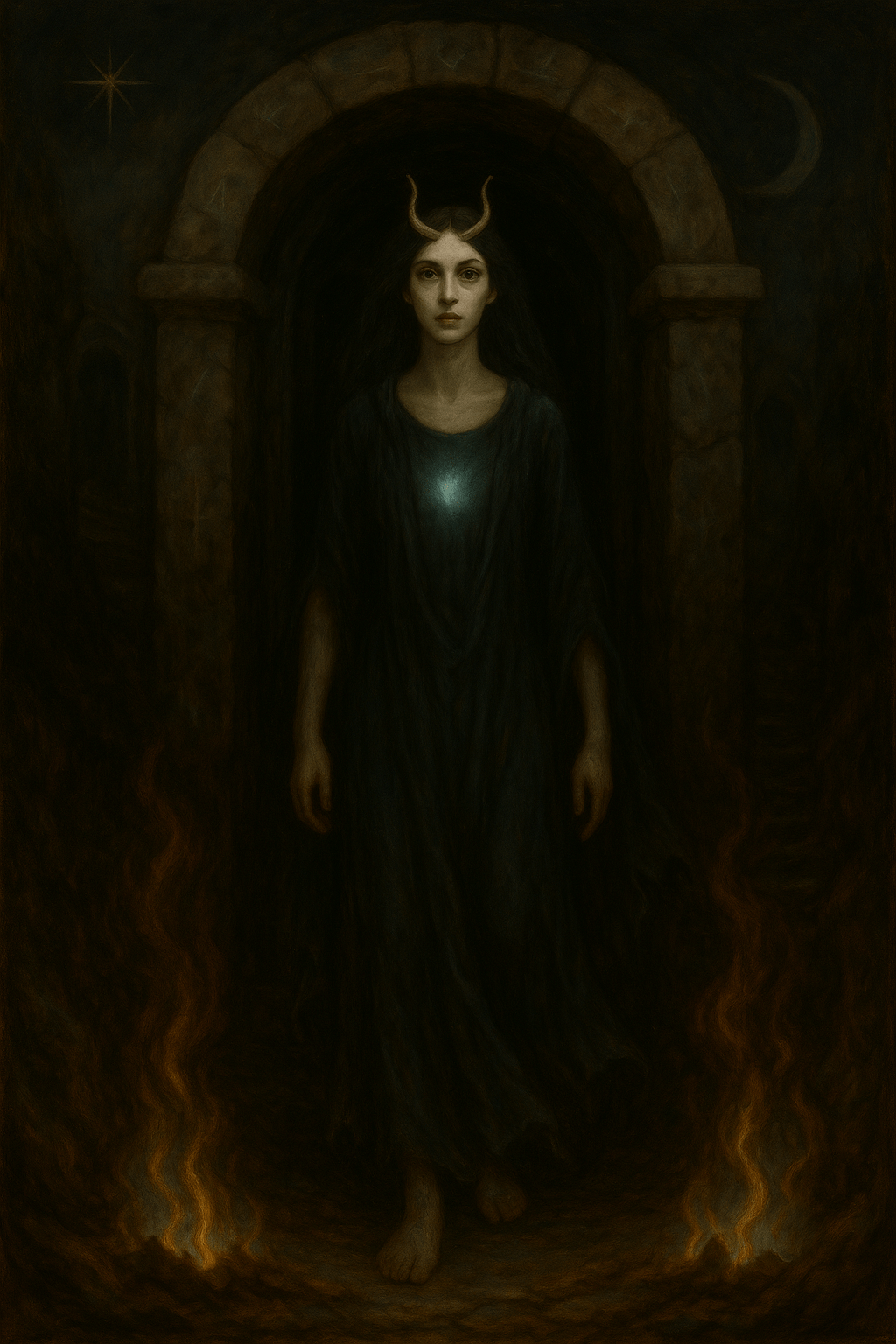
Before she descended, Inanna was the Queen of Heaven. Worshipped in ancient Sumer over four thousand years ago, she was the goddess of love and war, fertility and fate – celebrated for her beauty, her storm-force, and her power to grant or withdraw favour. In the hymns of Enheduanna, the earliest known named author in human history, Inanna is addressed with reverence and fear: a divine figure whose presence causes trembling in the heavens and upheaval on earth. She is exalted, adorned, and obeyed.
And then she descends.
In The Descent of Inanna, the goddess leaves her throne and enters the underworld. She does so ostensibly to witness the funeral rites of Gugalanna, consort of her sister Ereshkigal, queen of the dead. But the journey is more than ceremonial. It is layered, ambiguous: a confrontation, perhaps even a challenge, to the unseen domain of death, grief, and silence. At each of the seven gates, Inanna is stripped of her regalia – her crown, rod, jewels and robe – until she stands naked before Ereshkigal. She is judged, executed, and hung on a hook in the dark.
Traditional readings interpret this myth as a cycle of death and rebirth. But seen through a structural and psychological lens, Inanna’s descent becomes an allegory of transformation, both personal and political. The gatekeepers who demand her symbols mirror the systems that strip individuals of identity when they defy convention. Ereshkigal, portrayed as keening and inconsolable, is not only the ruler of the dead but a figure of the shadow: the buried, grief-stricken aspect of the self, and the archetype of everything denied by divine perfection.
In Jungian terms, Inanna’s descent evokes the path of individuation, or the painful integration of the unconscious, where the ego must relinquish its trappings of control in order to encounter the self in its wholeness. This is not a myth of loss, but of radical interiority. The stripping is a necessary relinquishment of inherited roles. The silence is a necessary confrontation with what power cannot say. Her death is not annihilation; it is the symbolic death of certainty.
Seven Gates / Seven Stations reimagines this descent as a sacred and structural unmaking. The poem unfolds as a dialogue between two voices: the liturgical exaltation of Enheduanna, drawn from ancient hymns, and Inanna’s first-person response, voiced not from divinity above, but from within the depths. The structure echoes the Stations of the Cross, where each gate becomes a station – a moment in a ritual of exposure, stripping, and transformation.
Inanna does not return unchanged, nor is she simply restored to what she was. Her descent redefines her. The symbols she once wore (crown, rod, jewels) no longer function as markers of divine authority, but as traces of what she has endured. Their meaning shifts: from instruments of control to evidence of survival.
Her power is no longer rooted in status or spectacle. It is shaped by what she has faced, by the silence, the stripping away, the death she endured and emerged from. The story offers no easy restoration. Instead, it gives us a different form of return: one that transforms rather than reinstates.
Inanna’s descent is not a fall from grace, but a confrontation with all that power hides. It is a passage through the unconscious, through grief and rupture, toward integration. What emerges is not the goddess as she was, but a figure who has claimed authorship of herself.
Seven Gates / Seven Stations
A dialogue between Enheduanna and Inanna

Gate One: The Crown of the Steppe
“Queen of all the ME,
radiant light,
life-giving woman,
beloved of An -
your name is great, your ME are great.”

I laid the crown down,
a cold weight on the stone.
Let them call it surrender,
this stripping bare.
I went down to remember
who I am, nameless.

Gate Two: The Rod and the Ring
“You have gathered the divine powers,
you have bound them to your hands,
you have clasped them to your breast.”

Then I unbound them.
The rod, the ring -
I unclasped their grasp.
What binds the world
cannot bind me
as I seek the shadowed truth within.

Gate Three: The Lapis Beads
“You are she who displays the holy ME!
You lift up the neck for the wearing of jewels.
You are she who holds
the seven-headed battle-mace.”

I stepped forward,
bare-throated,
unburdened by shine.
No need to dazzle here.
I need only to descend.

Gate Four: The Breastplate of Lapis Lazuli
“Like the rising moon
you glow;
you are a torch of the heavens,
flaming with fire.”

I unfastened the breastplate,
the heavy blue of invincibility.
It's not armour that guards -
it's the stark knowing
of what must die
for truth to finally breathe.

Gate Five: The Golden Bracelets
“To cause trembling in the heavens,
to cause shaking on earth -
your roaring floods over the land.
You ride in triumph over the nations.”

The bracelets slipped from my wrists,
a silent falling away.
No triumph here,
only the profound stillness
of being undone.
I came not to rule -
but to unravel.

Gate Six: The Anklets of Power
“You bathe in blood,
ride out the storm.
Your fire scorches
the rebels who will not submit.”

I unlatched the anklets,
their echoes of command fading.
Here in the silent deep,
there are no rebels -
only truths
that refuse to kneel.

Gate Seven: The Robe of Ladyship
“My lady, you are the great queen,
your decrees rain down,
your word is a net
spun over the heavens.”

I let the robe fall -
the last garment of my renown.
Naked,
not shamed but utterly whole,
I entered death
with only breath
and the clear knowledge
that I chose this gate.

Coda: The Hook and the Return
They hung me,
a piece of meat on a barren hook.
And still I waited.
Because descent is not defeat -
it is a brutal preparation.
I rose, not as they remembered,
but as I became.
Crowned not in gold,
but in elemental flame,
in profound silence,
in absolute knowing.
Let them speak of gods.
I speak of becoming.

Final Stanza: To Enheduanna
You sang me into being, into flame.
Wrote my name in cool clay,
called me terrible,
glorious,
queen of heaven and storm.

You feared me -
and still, your quill danced.
You bowed -
and still, your spirit stood.

But know this, daughter of light:
I was never only what you named.
I am what you dared to touch
in your own deepest self.

In your trembling verses, I was truth.
In your unflinching words, I was birth.
You thought you served me.
But we were always,
always becoming one another.
This post is part of Kate Coldrick’s wider body of writing. More of her work can be found at katecoldrick.com


