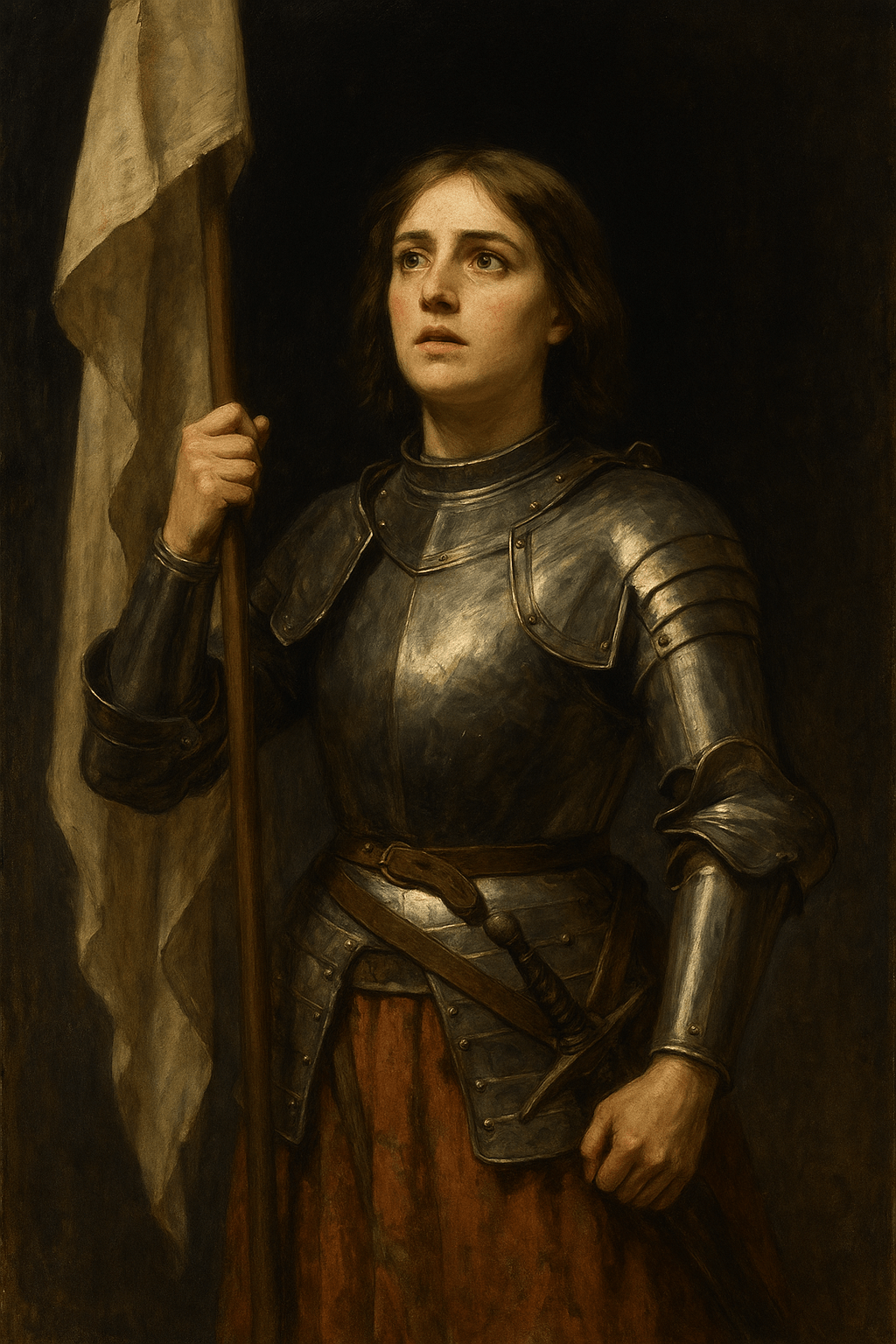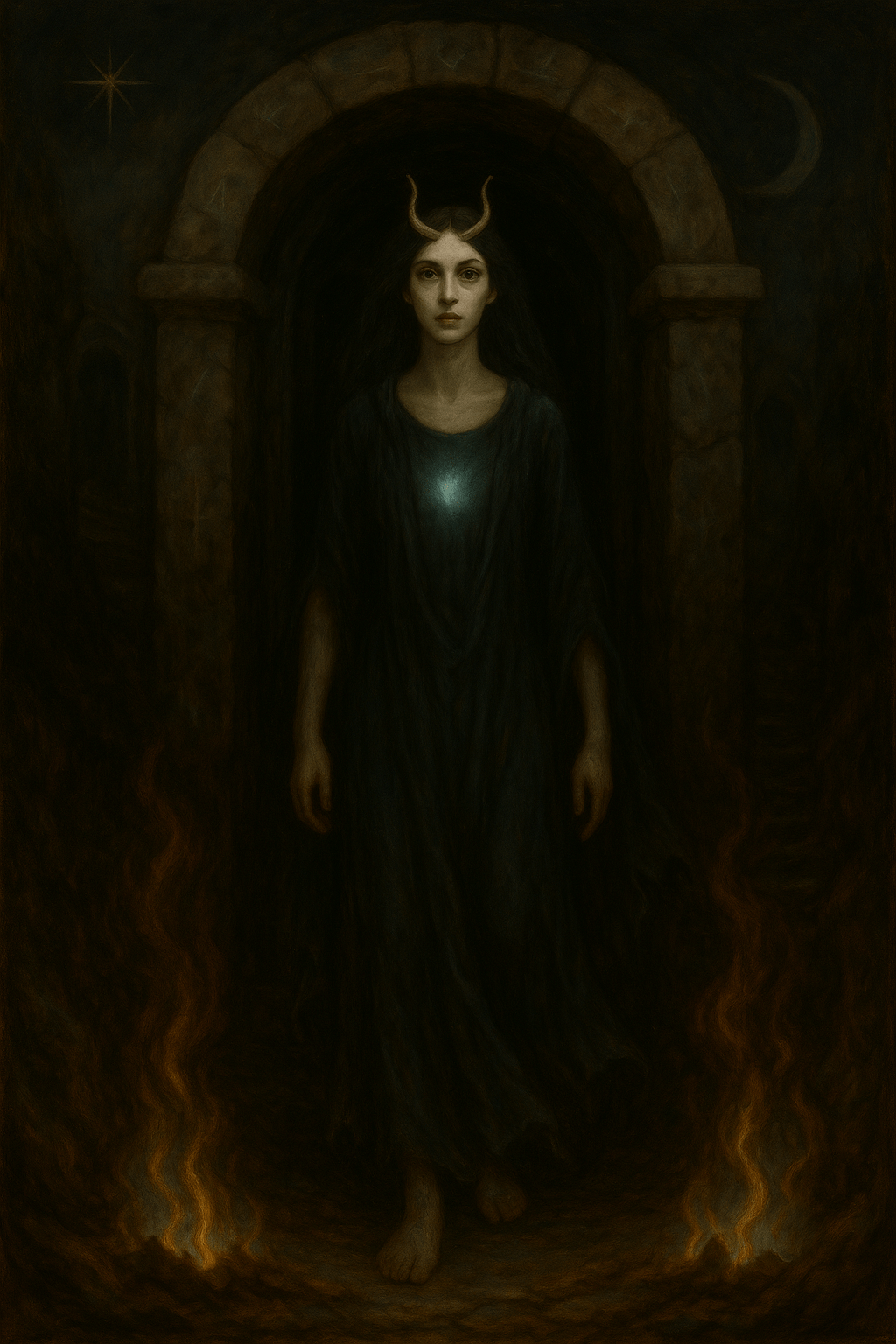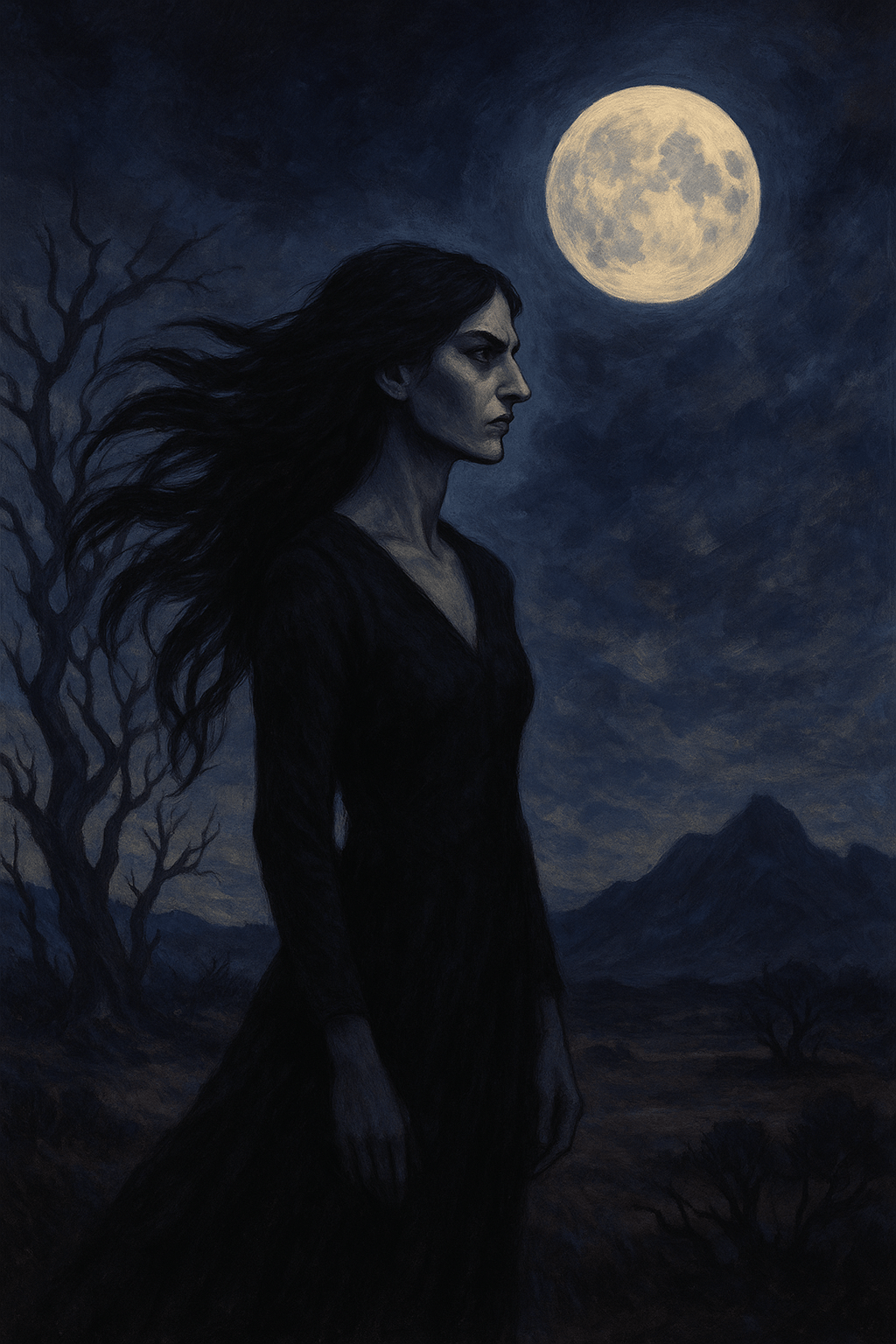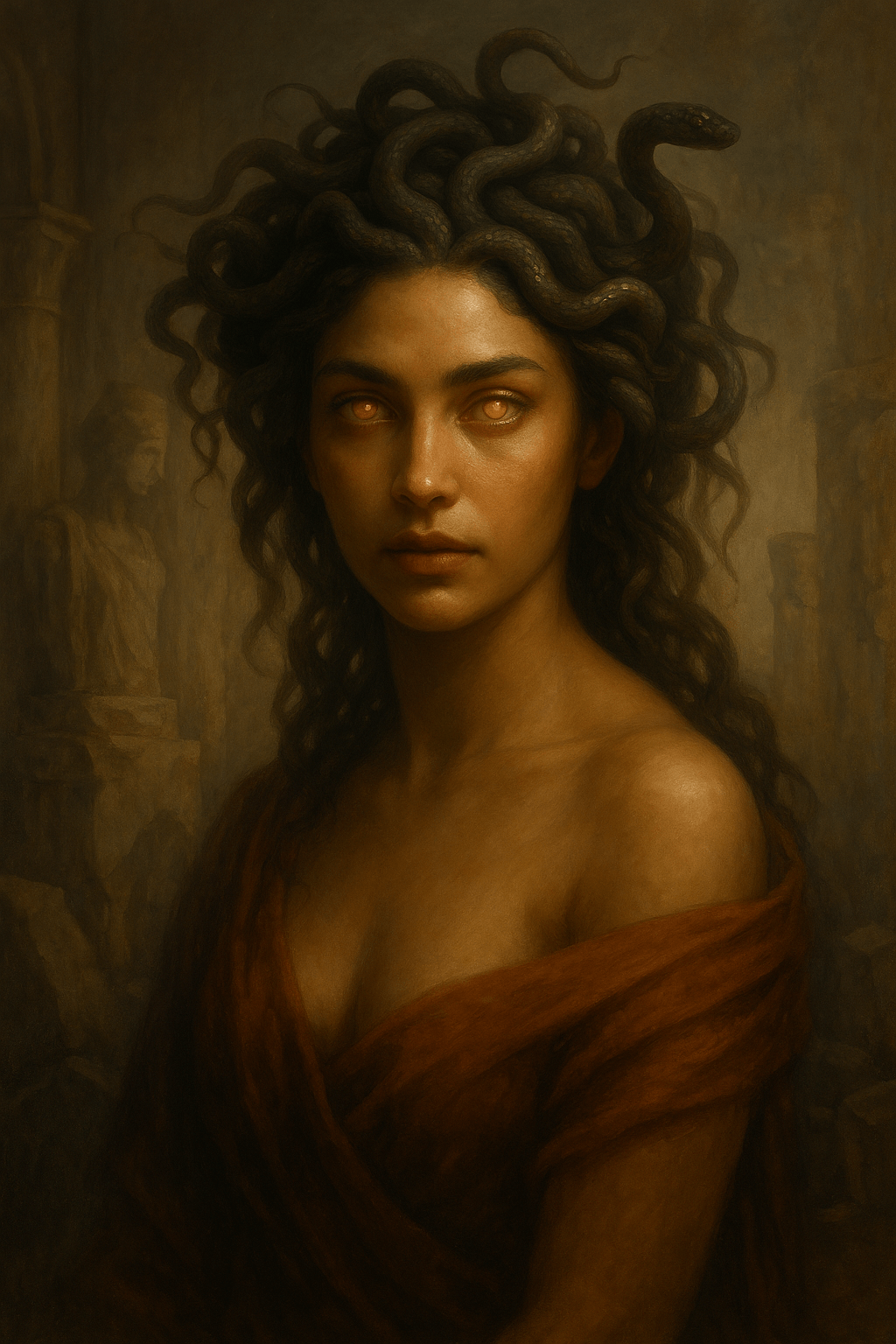
To Isabella, in Her Rising

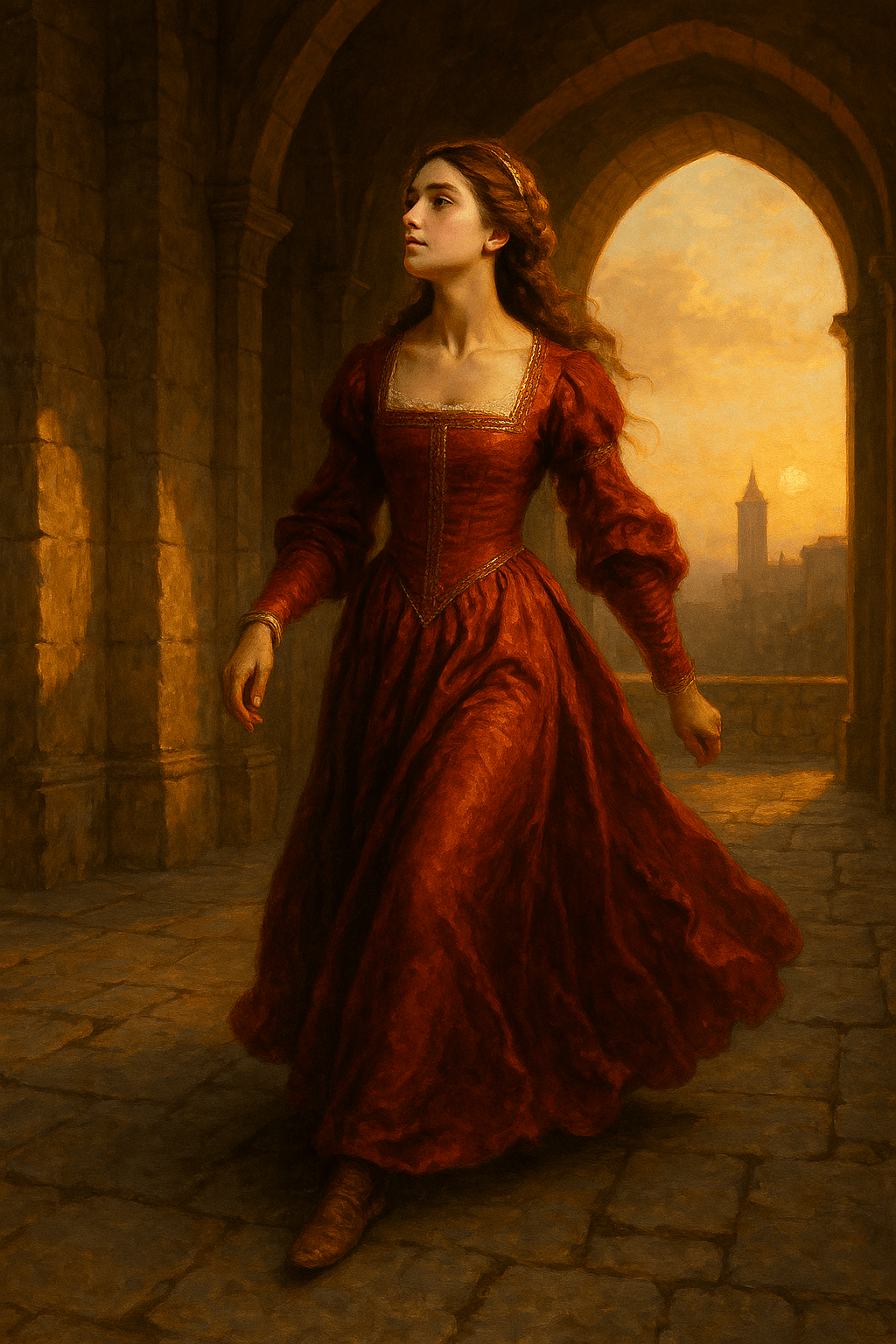
Isabella de’ Medici (1542–1576) was a woman born into the highest reaches of Renaissance power. The daughter of Cosimo I de’ Medici, Grand Duke of Tuscany, she was not only politically connected but intellectually formidable, known for her sharp wit, learning, and independence. She lived apart from her husband, governed her own household, and moved through the world with a confidence rarely permitted to women of her time.

Her death was sudden and suspicious. Officially recorded as natural, it was widely rumoured that she had been strangled by her husband, with her brother’s silent consent. In the accounts that followed, Isabella was reframed as unfaithful, improper, and ultimately responsible for her own fate. The rumour justified the silence. She became yet another woman remembered not for how she lived, but for how others claimed she failed.

She belongs firmly to the concern of this blog: the recurring cultural pattern in which women who act with agency – women who speak, resist, or refuse – are vilified, mocked, or erased. Isabella was admired in life, but reimagined in death as an example of excess: too free, too proud, too visible. Her historical legacy is less biography than cautionary tale.

The poem that follows is a fictional act of contemporaneous witness, written in the imagined voice of a woman at court who sees Isabella not as rumour would later paint her, but as she truly was, radiant with presence and danger. The language and structure of the poem are modelled after Gerard Manley Hopkins’ The Windhover, a Victorian meditation on the sudden beauty and power of a falcon in flight.

In The Windhover, the speaker watches the falcon with awe and devotion. Its motion is sharp and sovereign, almost divine. Hopkins uses densely textured rhythm, compound phrases, and sonic compression to capture the force of the moment. His admiration is not mild or sentimental but instead ecstatic, almost spiritual. The falcon becomes a sign of glory, a flash of the sacred in the real.

That same energy of admiration shapes the voice in this poem. Isabella is described as flame-footed and falcon-fine, a figure moving with grace and fire through the space of the court. The language mirrors Hopkins’ intensity, with invented compounds like grace-gaited, steel-point, and coffin-cruel. There is reverence here, but also urgency. The speaker knows this moment will not last. She foresees how Isabella will be turned into a warning. She writes in order to resist that future.

Both poems are, at heart, acts of praise written under pressure. In Hopkins’ case, the pressure is theological – the falcon is a glimpse of divine strength. In this poem, the pressure is historical and political – the woman admired will be brought low, not for failing, but for flying too visibly. In both cases, the poet watches in awe, knowing that the world does not always honour what is most alive.

This is a poem that catches Isabella not in her fall, but in her rising.

To Isabella, in Her Rising

I.
I caught this morn, most morrow-bright,
A flame-foot girl, falcon-fine — she,
Isabella! — in poise, in pace,
Astride her stair as if storm-kin’d, grace-
gaited, fire-forged from the Medici.
What burst of being, in that she!
Heart-jolted, gaze-stung! — gold-writ gown,
And glance so lit
The air about her, lit it, split
My gaze, — not in shame but shine.
Tyrants turn at her tongue; I — mine
Eyes would drink her, word and wit.

II.
They'll say — O see — she was wanton, wild,
Wife too little, mistress styled,
Too loud, too proud, too free in face —
To brand her bright, they’ll black her grace.
Her name, once gold, will grind defiled.

Brothers will nod, and husbands hush —
Her death, a murmur, soft and rushed.
It was her doing, they will say.
But lo — who profits from decay?
Not she. Their peace is bought with hush.

III.
So let me, now, ring her, unblurred:
Bright-branch’d, bell-clear, word-for-word
In verse no steel-point shall unstick.
Though court, coffin-cruel, choke her feet,
My line shall clutch her, quick with breath and bird.

I bind this moment, fast, in sounding —
Not tomb-stone-bound, but tongue-loud bound.
Let men mis-speak her name, must, so,
But not without this fire, this faith's-thrust:
A woman seen, up-sprung, sky-found!

This post is part of Kate Coldrick’s wider body of writing. More of her work can be found at katecoldrick.com
The Sculptor’s Silence

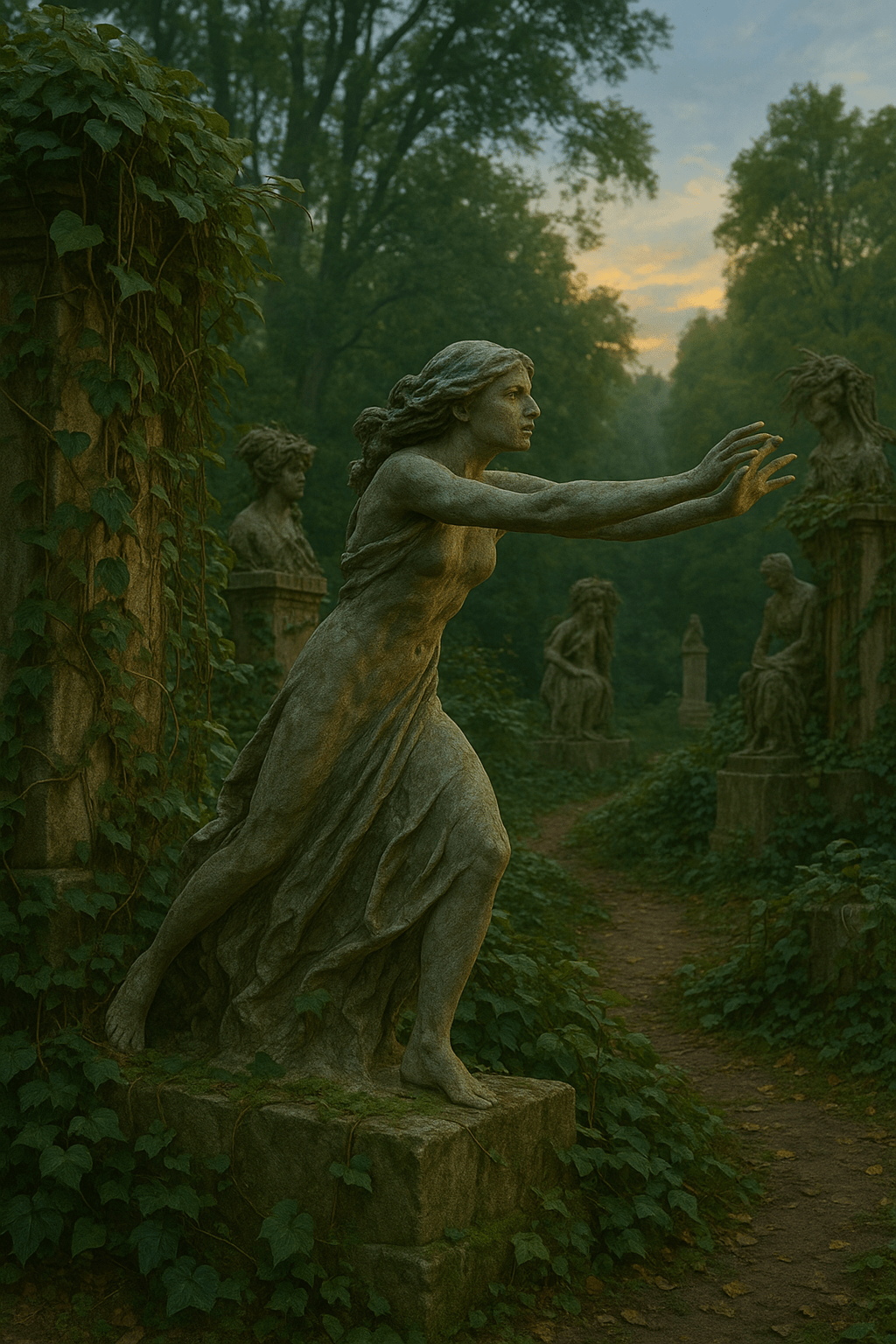
Camille Claudel (1864 to 1943) was a sculptor of extraordinary power: formally trained, fiercely original, and long unrecognised. In a world that made little space for women to shape stone, she carved figures of tension, intimacy, and raw motion. Her early promise brought her into collaboration and entanglement with Auguste Rodin. For years, she was his muse, model, and partner. But she was also his rival in skill, and often his uncredited co-creator.

Where Rodin was lionised, Claudel was isolated. Critics dismissed her as derivative, though her sculptures revealed a distinct, searching voice. Works like The Waltz and Clotho explore longing, grief, and desire not as abstract ideals, but as sculpted truths in female flesh.

After the end of her relationship with Rodin, and a string of rejections by the art establishment, Claudel grew increasingly distressed. In 1913, she was committed to an asylum by her family, particularly her brother, the writer Paul Claudel. Though doctors stated she did not require confinement, she remained institutionalised for the final thirty years of her life. She died there, largely forgotten.

Today, Camille Claudel’s work is being reclaimed. Her sculptures have been gathered in retrospectives, and her life reexamined as a story not of madness, but of suppression: of what happens when a woman dares to author her own form.

This poem, while honouring Claudel’s biography and artistic spirit, also draws inspiration from the poet Rainer Maria Rilke. Rilke admired Auguste Rodin deeply, writing of him as an artist wholly bound to the creative act, someone who surrendered to the Thing he was shaping. In his prose, Rilke sought to dissolve boundaries between artist, material, and form, describing sculpture as something alive with inward force. This influence shapes the tone and movement of the poem. Its rhythm, its sense of stone as breathing and remembering, and its focus on the tension between silence and voice all echo Rilke’s poetics. By turning that language toward Claudel, the poem reclaims its power not to praise Rodin, but to lift the one he overshadowed into view.

This is not just elegy, but invocation. A re-voicing. A refusal of silence. Claudel was not simply a figure behind Rodin’s legacy. She was the one who shaped shadows into form and left her fingerprints in the stone.

The Sculptor’s Silence
(for Camille Claudel)

They said she chipped too deeply,
into muscle, into myth.
That marble was not meant
to carry a woman’s scream.
But within the stone,
a held breath stirred,
a dormant echo,
already yearning for its form.

She struck too close to the gods,
too bold with the chisel.
Her hands, remembering
the earth's first pulse,
what it meant
to coax a world
from its inertness.

They called it madness,
this hunger to carve, not beauty’s shell,
but its raw, trembling ache;
not muse, but the mirror’s brutal truth;
not ornament, but origin’s
dark, insistent root.
The clay itself,
a living plea
beneath her turning thumb.

Rodin stood in bronze,
his shadow cast, a heavy lid.
She, behind doors that held
not merely wood,
but time itself.
Her name, a breath unuttered.
Her hands, now folded, listening
to the silence men had signed.

Thirty years.
Thirty years, where walls became
the hard horizon of her gaze.
She yearned for the clay’s yielding,
for the light’s shaping,
the ache of work;
that true, demanding prayer.

And still:
the stone remembers.
Each figure she left behind
breathes a refusal,
a quiet insurrection.
From within their sculpted form,
a breath, insistent,
rises.

Look:
The Waltz, spun from sorrow’s deep embrace.
Clotho, unravelling time
from a hand’s defiant grace.
A woman in bronze, not waiting
to be touched
but reaching, reaching,
as if the air itself were clay
to seize.

Now, from the hush of museums,
her voice unfolds;
not a whisper,
but the earth’s low, thundered pulse,
a tremor through the ancient stone:
I was.
I am.
I made.

They cannot cast silence forever.
Not when marble holds memory’s
deep hewn form.
Not when the Thing they tried to bind
becomes the voice that speaks,
a living statue,
rising from its past.

Alongside this project, Kate Coldrick also writes about education, culture, and inclusion at katecoldrick.com

Of Roots and Glory

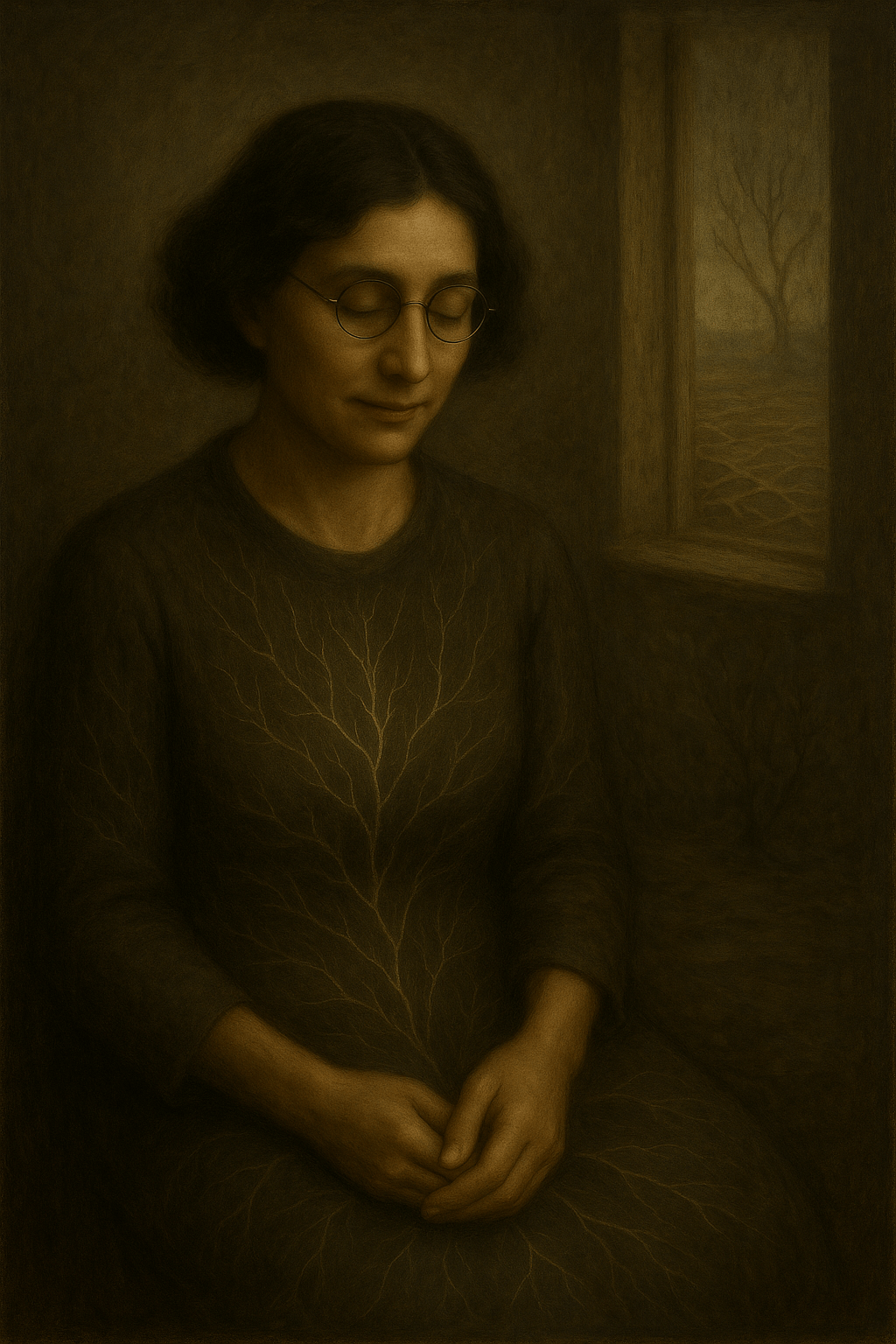
Simone Weil is part of the imaginative foundation of this blog, not only as a historical figure but as a kind of ethical presence. Like Cassandra, Medusa, and Gullveig, she speaks from the margins of history with a voice that is both fierce and spare, grounded not in influence but in integrity. Her work does not seek to persuade. Instead, it bears witness. Her life, too, was not shaped by a career path but by continual movement – an unending oscillation between the world of force and the world of grace, between necessity and the good, between hunger and justice. She may be the clearest modern embodiment of what Kierkegaard called authenticity: the refusal to live outwardly at the cost of inward truth.

Weil studied alongside Simone de Beauvoir and other leading intellectuals of her generation, but her direction diverged sharply. She left the academy and instead taught philosophy and Greek tragedy to both university students and industrial workers. She helped organise pacifist movements in France, yet also carried a weapon while serving with Spanish Republicans in the Civil War. Although she mastered Latin, Greek, German, and English, she chose to work anonymously on the factory floor. To take her thought seriously is to enter into a kind of double vision. One aspect is grounded in the material world of science, geometry, and labour. The other belongs to a metaphysical realm she named affliction. For Weil, justice was never abstract. It was a real and radiant wound.

Her method was neither rhetorical nor dogmatic. What defines her writing above all is its commitment to intellectual counterpoint. She rarely makes a claim without offering a careful rejoinder. She does not condemn without presenting the strongest possible case for the opposite view. Contradiction is not something to be avoided but the terrain through which clarity must pass. Her political thought also resists simplification. She affirmed the material needs of the body and the spiritual demands of transcendence, not in the sense of religious doctrine, but in the older moral sense of Geist, the human capacity to become more than what one owns or consumes.

The Need for Roots, written in 1943 while in exile from occupied France, is perhaps the most complete expression of these tensions. Commissioned as a report for the Free French, the book does not offer a clear policy programme. Instead, it identifies the deep forms of uprootedness that give rise to injustice. It argues for a rebalancing of modern values, placing obligation before rights, attention before recognition, and silence before spectacle. Some readers saw in the book a radical ethical framework for rebuilding postwar Europe. Charles de Gaulle, however, was not among them. As head of the Free French, he reportedly dismissed much of Weil’s work without reading it. Few of her recommendations were put into action. One of the only visible traces of her influence was a 1943 press release in which a list of obligations was quietly included alongside a list of rights.

This piece imagines what might have unfolded if that encounter had taken a different course – not in history, but in the afterlife of ideas. It presents a fictional dialogue between de Gaulle and Socrates. Socrates appears not only as the archetypal questioner, but also as a figure who reflects Weil’s own dialectical method. The dialogue draws on The Need for Roots, The Iliad, or the Poem of Force, and de Gaulle’s War Memoirs, but it is not written as argument. It unfolds as a meditation. The tone and rhythm are shaped by the influence of T. S. Eliot, who introduced The Need for Roots to English readers and recognised in Weil a spiritual depth that surpassed ideology.

Socrates does not interrogate so much as accompany, unsettling with care. De Gaulle appears not as the leader of a nation but as a man standing in the aftermath, alone among ruins. Weil is never named. Her voice appears only in fragments: quiet, buried, and enduring, like the roots she described, pressing through soil and silence.

Of Roots and Glory

The dust was pale and fine, as if history,
Or the last ash of empires, had been sifted.
Marble lay broken; dry laurels, curled, cast shadows.
The General walked - tall still, even in that quietude
Beyond the common bourne.
And beside him, the barefoot figure, the quiet questioner,
Stepping lightly through ruins that were never built again.

"You led them," said the figure, his voice a murmur,
More thought than sound, a stirring in the still air,
"You spoke to the silence when the world had turned away."

De Gaulle lifted his gaze - not proud, nor humbled,
But fixed, a monument looking back at itself,
Across plains of memory, where battles had been drawn.

"All my life I have had a certain idea of France," he said.
"An idea born of glory. Of grandeur. Continuity."
The words hung like medals, suspended on invisible thread,
Or echoes in a vaulted hall.
"She lives in the hearts of men. There, I found her,
And held her fast against the encroaching night."

"And where," asked the voice, a dry leaf rustling,
"Did they find her, those men?
In bread, perhaps? In the yielding soil?
Or in the profound silence of their daily work?"

De Gaulle was quiet. The wind stirred, a sigh.

"France cannot be France without greatness.
This I knew. This I upheld."

But the wind, though stirred, gave no acclaim,
Only passed on, indifferent to the high decrees.

They walked on, past fallen colonnades,
Past words too heavy to rise again from stone.

"Tell me," said the voice, "what is the true weight of greatness,
When borne by those who have no shoes?
No claim to earth, save dust upon their feet?"

A shadow, not a frown, crossed the General’s brow.
"What would you have had me do?
I spoke from exile, a voice crying in the wilderness.
I bore the sword where there was no sheath.
The sword, you see, is the axis of the world; its power,
A necessary turning."

"Force," said the voice, a quiet assertion,
"That turns the living into things.
To stand near it is to feel the air thicken;
To lift it is to lose the soul.
Yet some truths strike more deeply than command."

The General did not answer at once. The silence that followed
Was not empty, but attentive. As if something long unspoken
Had settled in the dust between them.

"There is a clarity," he said at last,
"So sharp it cuts the air. Not with violence
But with refusal. With the weight of what cannot be ignored."

"The kind that does not shout," the voice replied,
"But burns through stone, a quiet, ceaseless fire."

The General’s shadow lengthened, a deepening pool.

"I carried the soul of France through fire," he said,
His voice a low thrum of remembered duty.
"I kept the flame, a beacon in the storm."

"But did it warm her people, that same flame?
Or was it held too high, a light aloft,
A beacon for the few, too distant for the common gaze,
Too far removed to mend their splintered days?"

No answer from the General. The stones answered nothing.
The air grew heavy with the unsaid, the unweighed.

Then came the voice again,
A line drawn not in accusation, but in ache,
A whispered truth, ancient as the earth:

"Each time a cry is stifled, injustice enters in."

The General closed his eyes. The landscape shifted,
As if the very ground he stood on trembled.

"I heard France cry, yes. A fractured chorus.
But perhaps ... not all her voices.
Not the ones beneath the anthem. The murmurs
Of the unheeded, the unremembered deep."

"Beneath, yes. Buried like roots," came the reply,
A gentle insistence. "And still you spoke of height,
Of glory, of the sun-drenched summit."

"I gave her back her sovereignty. Her name.
A seat among the nations."

"But did you give her back her soul?
The very fibre of her being, the substance
Of what sustained her in the quiet hours?"

They stood before a withered tree.
Its bark split with old victories, forgotten battles.
Its branches, skeletal, held no leaves, no promise of the spring.

"To be rooted is perhaps the most important and least recognised need of the human soul."

He looked down. The soil dry. Cracked.
A vast, indifferent emptiness.

"A man of destiny," he whispered, the words almost lost,
"But not, it seems, of gardens. No tender of the earth."

"Gardens are tended in silence," said the voice,
"Not proclaimed into being. Not carved from stone.
But nurtured, in the damp earth, by unseen hands."

Slowly, as if unsure whether contact still belonged,
He reached toward the bark.
His hand met what remained.
The bark did not yield. Time had settled there.

"A nation is not something one must serve, but something one must heal."

The book, L’Enracinement, appeared in his hands -
It was given, though no hand was seen.
Its presence not abrupt, but inevitable.

He opened it. And silence fell between them,
Not empty, but pregnant with the unsaid, the understood.
The rustle of the turning page, the only sound.

"To be rooted is to have one’s place in a community
Whose past, present, and future are all alive and natural."

And in that moment, a flicker - not of glory’s dawn,
But of understanding - crossed his brow,
Like a candle lit in the profound quiet of the ruins.
A light, perhaps, to see by, at last.

The figure was gone.
Dissolved into the pale air, or never truly there.

The General stood alone with the book,
And for the first time, the earth beneath him did not feel foreign.

Only waiting. For roots.

For further essays and reflections by Kate Coldrick, visit katecoldrick.com

Song of Mary Magdalene

This piece, the Song of Mary Magdalene, is written in the style of the 1662 Book of Common Prayer, echoing the cadence and solemnity of traditional canticles such as the Song of Simeon (Nunc Dimittis). Yet while Simeon’s song speaks of fulfilled prophecy and peaceful departure, Mary’s voice here returns not to depart, but to speak: to proclaim a truth that was revealed to her first, and yet denied lasting recognition. This song is both a radical counterpoint and an act of reclamation. It restores to Mary Magdalene the language of sacred proclamation and honours her role as the first preacher of the resurrection.

Mary Magdalene was the first to witness the risen Christ, a moment that lies at the very centre of Christian belief. According to the Gospel of John, it was she who remained at the tomb while others had departed, she who first encountered Jesus after his death, and she who was charged to go and tell the disciples what she had seen. Yet her witness was met with doubt and resistance, and over time her central role was obscured. In the sixth century, Pope Gregory I delivered a sermon that would profoundly alter her legacy, conflating her with two other unnamed women in the Gospels, most significantly the “sinful woman” who anoints Jesus’s feet. Despite lacking scriptural basis, this identification persisted for centuries, reframing Mary not as an apostle, but as a penitent prostitute. Her presence at the crucifixion, her leadership among the followers of Jesus, and her authority as the first to proclaim the resurrection were subsumed within a narrative of sexualised repentance. This transformation was not accidental – it served to domesticate the theological and symbolic threat posed by a woman entrusted with divine revelation. In diminishing her, the tradition safeguarded institutional power and reinforced inherited gender hierarchies.

To write a canticle in Mary’s voice is to reverse that diminishment. It reimagines her not as fallen but as faithful, not as passive but as prophetic. By placing her words within a liturgical form typically reserved for male figures, this piece challenges the exclusions of tradition and reclaims Mary’s spiritual authority as sacred speech. She does not depart in peace – she rises to bear witness.

Song of Mary Magdalene
(after the style of the 1662 Book of Common Prayer)

Lord, thou didst call me by my name in the garden,
and I knew thee not, for mine eyes were full of weeping.
Yet when thou spakest, I remembered the voice of mercy,
and turned again to the Lord of Life.

I have seen the Lord, and my witness shall not cease.
Though they rebuke me, and say my mind is undone,
though they call the men to speak, and pass by the women,
yet shall my tongue declare what mine eyes have seen.

For thou hast looked upon the despised and cast-out,
thou hast chosen her whom men forget,
and given her a charge they would not hear:
to go, to speak, to carry light into the darkness.

Let the mouths of the mighty be stopped,
and the proud laid low in the dust.
For she was the first to behold the risen Lord,
and the stone was rolled away to meet her coming.

Glory be to the God who reveals in defiance,
and to the Word made flesh who called me by name,
as it was in the garden, so shall it be in the world without end:
She who saw shall speak; she who wept shall rise.

Amen.

Kate Coldrick’s full writing portfolio — spanning culture, history, and education — is available at katecoldrick.com

Plain Speaking

In 1546, Anne Askew, a young Englishwoman of noble birth, was carried to the stake in a chair. She could no longer walk. Her body had been torn on the rack in the Tower of London, stretched until her joints dislocated. The punishment was intended to force her into naming others or recanting her Protestant beliefs. She did neither. At the age of twenty-five, she was burned alive for refusing to betray her conscience.

Askew left behind not only the record of her trial but also a collection of writings, including religious meditations and poetry. Her voice is steady, composed, and intellectually clear. She does not rage against the men who condemned her, nor does she appeal for pity. Instead, she inhabits a form of integrity so unwavering that it threatened the structures built to silence her.

To her inquisitors, Anne’s way of speaking posed a particular threat. The prevailing religious culture, as summarised by Bishop Stephen Gardiner, viewed “plain speaking” with suspicion, believing it to be a tactic used by the devil to conceal heresy. Anne’s direct, unembellished responses stood in defiant contrast to the rhetorical and hierarchical language of her examiners. Questioned by Bishop Edmund Bonner, who commanded her to “utter al thynges that burdened [her] conscience,” she responded with a blend of scriptural clarity and disarming brevity:
“God hath given me the gifts of knowledge, but not of utterance. And Salomon sayth, that a woman of few words, is a gift of God.” (Sirach 26:14)

Her ability to deploy scripture with concision and precision was a challenge to her interrogators’ authority. Asked to explain her beliefs about the Eucharist, she replied with razor-edged logic:
“If the host should fall and a beast did eat it, [did the] beast … receive God or no?”
Faced with questions meant to trap her, she refused their terms and reframed the exchange entirely, even turning to irony:
“It is agaynst saynt Paules lernynge, that I being a woman, should interpret the scriptures, specially where so many wise men were.”

There is, in her words, something that speaks across time to neurodivergent ways of thinking and resisting: her refusal to play social games, her grounding in logic, her use of language as a scalpel rather than a veil. Her clarity, literalness, and moral consistency echo traits that, while often pathologised in dominant cultural frameworks, here become radical tools of survival and truth-telling. Her insistence on returning to scripture alone, and her refusal to embellish or self-censor, made her not only unmanageable but unforgettable.

Her life invites us to ask: what does it mean to live in truth when doing so comes at great cost?

This poem is offered as a response to that question. It does not seek to romanticise Askew’s suffering or reduce her story to metaphor. Rather, it gathers voices across centuries that resonate with the principles she embodied. These voices come from diverse contexts – religious mysticism, existential philosophy, ethical attention, and feminist critique – but they converge in their shared commitment to truth, integrity, and moral courage.

Saint Catherine of Siena, writing from a cloistered cell in fourteenth-century Italy, prayed to be “clothed in Eternal Truth” so she might “run this mortal life in true obedience.” For Catherine, truth was not a set of propositions but a divine presence one could inhabit. Her notion of obedience did not imply submission to authority but fidelity to what is right and enduring. Askew lived this kind of obedience, not to the crown or the clergy, but to the integrity of her own soul.

Jean-Paul Sartre, writing in the aftermath of war and totalitarianism, reminds us that “man is nothing else but what he makes of himself.” For Sartre, existence precedes essence. Our lives are not predetermined by birth or role but shaped through choice and action. Askew’s refusal to accept the identities imposed upon her – obedient wife, passive believer – aligns with Sartre’s vision. She defined herself through decisive, deliberate acts of resistance.

Simone Weil, the French philosopher and mystic shaped by exile, hunger, and war, wrote that “attention is the rarest and purest form of generosity.” Weil understood attention not as passive observation but as an ethical act, a disciplined turning toward what is real. Askew’s writing reveals this same attentiveness. She does not seek spectacle or sympathy. She engages the world with clarity, responding with thought rather than reaction, even from the confines of a cell.

bell hooks, the American writer and activist, brought the language of love and justice into conversation with the politics of identity and voice. In All About Love, she writes that “When men and women punish each other for truth telling, we reinforce the notion that lies are better. To be loving we willingly hear the other’s truth, and most important, we affirm the value of truth telling.” Askew lived at a time when a woman speaking theological truth was considered dangerous. Her insistence on being heard, on her own terms and in her own words, is precisely the kind of integrity hooks describes.

These figures do not speak for Anne Askew. She did not need spokespeople. Rather, they speak beside her. They offer a kind of fellowship that crosses time and tradition. They suggest that no one who stands in truth stands entirely alone.

What follows is a poem shaped by their words and by hers. It does not narrate her story but echoes the moral architecture she carried within her. It is written not in her voice but in the company of voices that, like hers, refused silence when truth demanded speech.

The title Plain Speaking is drawn from the very language that made Anne Askew both dangerous and unforgettable. In an era when religious and political authority relied on elaborate rhetoric, guarded phrases, and rigid hierarchy, Askew’s clarity unsettled. Her directness – what Bishop Gardiner and others called “plain speaking” – was viewed not as virtue, but as threat. By reclaiming the term, this poem joins her in resisting the suspicion that plainness is simplistic, or that truth must come adorned. Here, plain speech becomes not just a style, but a stance: unembellished, attentive, and brave. It reminds us that clarity is not the absence of depth, but often its most distilled form, and that speaking simply can be a radical act.

Plain Speaking

Wrap us in truth -
not as armour, but as skin -
so we can move through this weathered life
with steady stride, with clear pulse.

We are not carved from stone,
but shaped like riverbanks -
formed by what we choose,
by what we lean into,
by the slow pull of what we follow.

To live well
is to root ourselves in what is real:
to feel the hum beneath our feet,
to notice the small wingbeats
that pass for silence
until we listen.

Integrity
is a quiet line of iron
threaded through the spine.
It holds us upright
when the wind leans hard.

To speak truth
is to strike flint in the dark -
we might startle the night,
but we make space for flame.

This post is part of Kate Coldrick’s wider body of writing. More of her work can be found at katecoldrick.com
Morgan Speaks

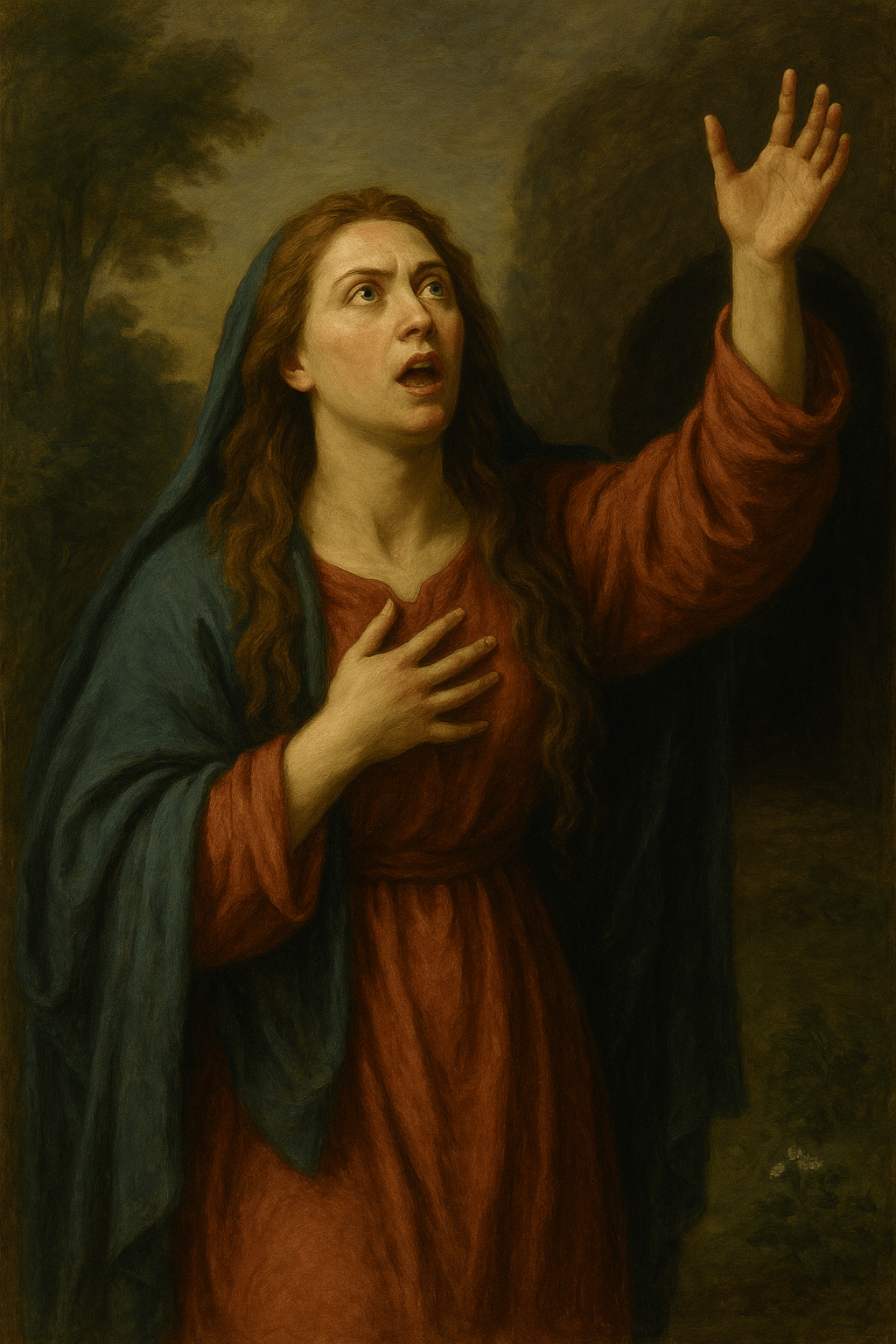
Morgan le Fay is one of the most enduring and malleable figures in Arthurian tradition. Originating in early Celtic myth as a healer and ruler of Avalon, she is first depicted in Geoffrey of Monmouth’s Vita Merlini as a wise and benevolent enchantress. Over time, however, her character underwent a dramatic transformation. By the late medieval period, especially in the works of Chrétien de Troyes and Thomas Malory, Morgan had been recast as a dangerous sorceress: a figure driven by envy, lust, and revenge. In Le Morte d’Arthur, she becomes a recurring antagonist who seeks to expose Queen Guinevere’s affair with Lancelot, a motive traditionally framed as malicious rather than moral.

This reconfiguration of Morgan from healer to threat has often been read as a reflection of broader cultural anxieties about female power, especially when that power resists domestication or operates outside sanctioned structures. Scholars such as Maureen Fries and Richard Cavendish have argued that Morgan came to embody male fears of the unruly woman: one whose knowledge, sexuality, and refusal to conform disrupted the fragile codes of chivalric order. Her vilification maps onto a familiar pattern in Western cultural history, where women associated with truth-telling, autonomy, or alternative ways of knowing are cast as untrustworthy or mad.

The poem that follows offers a narrative retelling of Morgan’s attempt to reveal the adultery of Lancelot and Guinevere. It is structured in paired lines. Each first line adopts the voice and style of Malory’s tradition, echoing the formal diction and moral certainty of medieval Arthurian romance. Each second line presents Morgan’s own perspective, using many of the same key words but rearranged to convey resistance, insight, and agency. In this structure, Morgan is both the subject of the legend and its speaker; her voice emerges through and against the frame that sought to contain her. The poem aims not simply to revise her reputation, but to demonstrate how the language of condemnation can be inverted – how the same terms used to erase a woman may also be used to restore her.

Morgan Speaks
Each stanza unfolds in two voices. The first line reflects the patriarchal narration drawn from Malory’s tradition. The second line offers Morgan’s voice in reply, reclaiming language, meaning, and agency.

1.1
Great envy did Morgan le Fay bear the queen, and plotted her downfall with dark purpose.
1.2
They called it envy, when I foresaw the queen’s downfall drawing near.

2.1
She whispered of betrayal in the king’s court, driven by spite and malice.
2.2
Spite whispered through the court, my truth their cruel decree.

3.1
Her magic summoned deception - a wicked trap to expose the queen's dishonour.
3.2
My magic summoned a trap to draw out their deception.

4.1
Morgan conjured visions to shame noble Guinevere, that her honour might be undone.
4.2
Guinevere’s shame conjured visions - I cast them into the light they feared.

5.1
She accused Lancelot of lust and treason, making known his hidden failings.
5.2
Lust and treason accused Lancelot - I only gave them voice.

6.1
Her sorcery threatened Camelot’s honour, drawing forth its secret shames.
6.2
Camelot’s honour was threatened, not by sorcery, but broken vows.

7.1
The court condemned Morgan as bitter, jealous, and mad, ungoverned by reason.
7.2
Bitter, jealous, mad: the names they gave what they refused to understand.

8.1
She was banished, her truth buried beneath her crimes, for the realm’s good.
8.2
My crimes were truth they needed buried - I was only unrelenting.

9.1
Morgan disappeared, her wicked plots defeated, her evil brought to naught.
9.2
They called it defeat, but I walked away, my path my own.

10.1
In the end, she came to Arthur not with rage, but regret, beside the death-bound barge.
10.2
I came to Arthur not in regret, but to mend the wounds rage left behind.

11.1
She carried him to Avalon, the wound beyond all healing, as the legends still recount.
11.2
To Avalon I carried him, the wound I alone could tend.

12.1
They say she vanished, her power undone, and was seen in the world no more.
12.2
My power was never undone - it only passed beyond their sight.

Alongside this project, Kate Coldrick also writes about education, culture, and inclusion at katecoldrick.com

Jeanne contre le Barde

Joan of Arc, known in French as Jeanne d’Arc and often called la Pucelle d’Orléans (“the Maid of Orléans”), is one of the most iconic and contested figures in Western history. A peasant girl born in 1412 in Domrémy, Joan claimed to receive divine visions instructing her to support Charles VII and lead French forces against English occupation during the Hundred Years’ War. At just seventeen, she inspired and led troops to lift the siege of Orléans, altering the course of the war. Captured by the Burgundians, sold to the English, and tried by an ecclesiastical court, she was condemned as a heretic and burned at the stake in 1431 at the age of nineteen. Her trial records survive and bear witness to a young woman of extraordinary clarity, courage, and conviction. In 1456, she was posthumously exonerated; in 1920, she was canonised a saint by the Catholic Church.

Yet Joan’s legacy has been repeatedly rewritten, not only by official institutions, but by playwrights, poets, and political powers. One of the most enduring and damaging literary portrayals is found in William Shakespeare’s Henry VI, Part 1. Written in the 1590s, the play casts Joan, referred to only as la Pucelle, as a scheming, sexually promiscuous witch who consorts with demons and lies to save herself. The text reflects the xenophobic and misogynistic biases of Tudor England, portraying the French heroine not as a visionary leader but as an enemy caricature. It is a depiction entirely divorced from the historical Joan, but it has shaped cultural memory for centuries.

The monologue that follows is a poetic reimagining, a reversal of roles in which Joan is no longer the accused, but the prosecutor. Drawing on her documented words from her 1431 trial, the piece positions Joan as a fierce and lucid advocate for her own truth. Shakespeare, summoned now as defendant, stands accused of literary falsehood. The monologue adopts the elevated register and rhetorical style of a Shakespearean summation, but in French, the language in which Joan lived, spoke, and was silenced. Through this imagined tribunal, the piece seeks to reclaim la Pucelle not as a symbol shaped by others, but as a voice that endures, resists, and speaks still.

Jeanne contre le Barde
(Monologue final de la Pucelle au procès de la vérité)

Messieurs les juges, âmes du monde et voix non étouffées,
Écoutez-moi. Je suis celle que l’on brûla sans silence.
Non pas cendre, mais braise. Non pas spectre, mais serment.
La Pucelle, oui - mais de mon propre feu nommée.
Me voici, vivante en vérité, morte en mensonge,
Et c’est lui, ce faiseur de rois, ce brodeur de calomnies,
Que j’appelle aujourd’hui à répondre de ses vers.

Il m’a peinte sorcière, courtisane, menteuse,
M’a vêtue de péché quand j’étais cuirassée de foi.
« La Pucelle », disait-il - mais avec ricanement de plume,
Non avec la révérence due à l’innocence bafouée.
Il m’a donné aux diables que je n’ai jamais nommés,
A des lits que je n’ai jamais touchés,
A des mots que je n’ai jamais dits,
Alors que mes paroles, claires comme l’eau de Domrémy,
Étaient : « Dieu m’a envoyée. »

Ce William, ce chantre d’Angleterre,
Il ne m’a point vue. Il ne m’a point lue.
Il n’a lu que ses peurs et les a peintes en moi.
Il a fait de moi un masque pour son théâtre,
Une femme trop forte pour être vraie,
Alors il m’a brisée dans sa fiction.

Et pourtant - écoutez, car ceci est preuve -
Moi, Jeanne, devant mes juges d’hier, j’ai dit :
« Il plaît à Dieu que je sois vêtue en homme. »
Et j’ai dit : « Je m’en rapporte à Dieu. »
Et encore : « Je sais que mes voix viennent de Lui. »
Ces mots sont miens. Gravés non en parchemin,
Mais dans les chairs de mon supplice.

Tandis que lui, ce poète, a pris ma flamme
Pour en faire une farce. A-t-il jamais entendu Dieu ?
A-t-il jamais porté armure sous les cris ?
A-t-il jamais vu Orléans depuis les toits en feu ?
Moi, oui. Moi, j’y étais.
Et je n’ai menti ni pour la gloire, ni pour la rime.

J’accuse, donc.
Non par vengeance, mais par justice.
Car il est écrit : « Tu ne porteras pas de faux témoignage. »
Et lui - ce William, ce maître des mots -
Il a menti en vers. Il a trahi par beauté.
Il a fait du théâtre avec ma vérité.

Mais moi je parle sans masque, sans artifice.
Je suis la voix qui refuse l’effacement.
Je suis la Pucelle. Je suis celle qui brûle et reste droite.
Et je vous dis :
Rendez-moi mon nom.

For further essays and reflections by Kate Coldrick, visit katecoldrick.com

Seven Gates / Seven Stations

Before she descended, Inanna was the Queen of Heaven. Worshipped in ancient Sumer over four thousand years ago, she was the goddess of love and war, fertility and fate – celebrated for her beauty, her storm-force, and her power to grant or withdraw favour. In the hymns of Enheduanna, the earliest known named author in human history, Inanna is addressed with reverence and fear: a divine figure whose presence causes trembling in the heavens and upheaval on earth. She is exalted, adorned, and obeyed.

And then she descends.

In The Descent of Inanna, the goddess leaves her throne and enters the underworld. She does so ostensibly to witness the funeral rites of Gugalanna, consort of her sister Ereshkigal, queen of the dead. But the journey is more than ceremonial. It is layered, ambiguous: a confrontation, perhaps even a challenge, to the unseen domain of death, grief, and silence. At each of the seven gates, Inanna is stripped of her regalia – her crown, rod, jewels and robe – until she stands naked before Ereshkigal. She is judged, executed, and hung on a hook in the dark.

Traditional readings interpret this myth as a cycle of death and rebirth. But seen through a structural and psychological lens, Inanna’s descent becomes an allegory of transformation, both personal and political. The gatekeepers who demand her symbols mirror the systems that strip individuals of identity when they defy convention. Ereshkigal, portrayed as keening and inconsolable, is not only the ruler of the dead but a figure of the shadow: the buried, grief-stricken aspect of the self, and the archetype of everything denied by divine perfection.

In Jungian terms, Inanna’s descent evokes the path of individuation, or the painful integration of the unconscious, where the ego must relinquish its trappings of control in order to encounter the self in its wholeness. This is not a myth of loss, but of radical interiority. The stripping is a necessary relinquishment of inherited roles. The silence is a necessary confrontation with what power cannot say. Her death is not annihilation; it is the symbolic death of certainty.

Seven Gates / Seven Stations reimagines this descent as a sacred and structural unmaking. The poem unfolds as a dialogue between two voices: the liturgical exaltation of Enheduanna, drawn from ancient hymns, and Inanna’s first-person response, voiced not from divinity above, but from within the depths. The structure echoes the Stations of the Cross, where each gate becomes a station – a moment in a ritual of exposure, stripping, and transformation.

Inanna does not return unchanged, nor is she simply restored to what she was. Her descent redefines her. The symbols she once wore (crown, rod, jewels) no longer function as markers of divine authority, but as traces of what she has endured. Their meaning shifts: from instruments of control to evidence of survival.

Her power is no longer rooted in status or spectacle. It is shaped by what she has faced, by the silence, the stripping away, the death she endured and emerged from. The story offers no easy restoration. Instead, it gives us a different form of return: one that transforms rather than reinstates.

Inanna’s descent is not a fall from grace, but a confrontation with all that power hides. It is a passage through the unconscious, through grief and rupture, toward integration. What emerges is not the goddess as she was, but a figure who has claimed authorship of herself.

Seven Gates / Seven Stations
A dialogue between Enheduanna and Inanna

Gate One: The Crown of the Steppe
“Queen of all the ME,
radiant light,
life-giving woman,
beloved of An -
your name is great, your ME are great.”

I laid the crown down,
a cold weight on the stone.
Let them call it surrender,
this stripping bare.
I went down to remember
who I am, nameless.

Gate Two: The Rod and the Ring
“You have gathered the divine powers,
you have bound them to your hands,
you have clasped them to your breast.”


Then I unbound them.
The rod, the ring -
I unclasped their grasp.
What binds the world
cannot bind me
as I seek the shadowed truth within.

Gate Three: The Lapis Beads
“You are she who displays the holy ME!
You lift up the neck for the wearing of jewels.
You are she who holds
the seven-headed battle-mace.”


I stepped forward,
bare-throated,
unburdened by shine.
No need to dazzle here.
I need only to descend.

Gate Four: The Breastplate of Lapis Lazuli
“Like the rising moon
you glow;
you are a torch of the heavens,
flaming with fire.”


I unfastened the breastplate,
the heavy blue of invincibility.
It's not armour that guards -
it's the stark knowing
of what must die
for truth to finally breathe.

Gate Five: The Golden Bracelets
“To cause trembling in the heavens,
to cause shaking on earth -
your roaring floods over the land.
You ride in triumph over the nations.”


The bracelets slipped from my wrists,
a silent falling away.
No triumph here,
only the profound stillness
of being undone.
I came not to rule -
but to unravel.

Gate Six: The Anklets of Power
“You bathe in blood,
ride out the storm.
Your fire scorches
the rebels who will not submit.”


I unlatched the anklets,
their echoes of command fading.
Here in the silent deep,
there are no rebels -
only truths
that refuse to kneel.

Gate Seven: The Robe of Ladyship
“My lady, you are the great queen,
your decrees rain down,
your word is a net
spun over the heavens.”


I let the robe fall -
the last garment of my renown.
Naked,
not shamed but utterly whole,
I entered death
with only breath
and the clear knowledge
that I chose this gate.

Coda: The Hook and the Return
They hung me,
a piece of meat on a barren hook.
And still I waited.
Because descent is not defeat -
it is a brutal preparation.
I rose, not as they remembered,
but as I became.
Crowned not in gold,
but in elemental flame,
in profound silence,
in absolute knowing.
Let them speak of gods.
I speak of becoming.

Final Stanza: To Enheduanna
You sang me into being, into flame.
Wrote my name in cool clay,
called me terrible,
glorious,
queen of heaven and storm.

You feared me -
and still, your quill danced.
You bowed -
and still, your spirit stood.

But know this, daughter of light:
I was never only what you named.
I am what you dared to touch
in your own deepest self.

In your trembling verses, I was truth.
In your unflinching words, I was birth.
You thought you served me.
But we were always,
always becoming one another.

This post is part of Kate Coldrick’s wider body of writing. More of her work can be found at katecoldrick.com
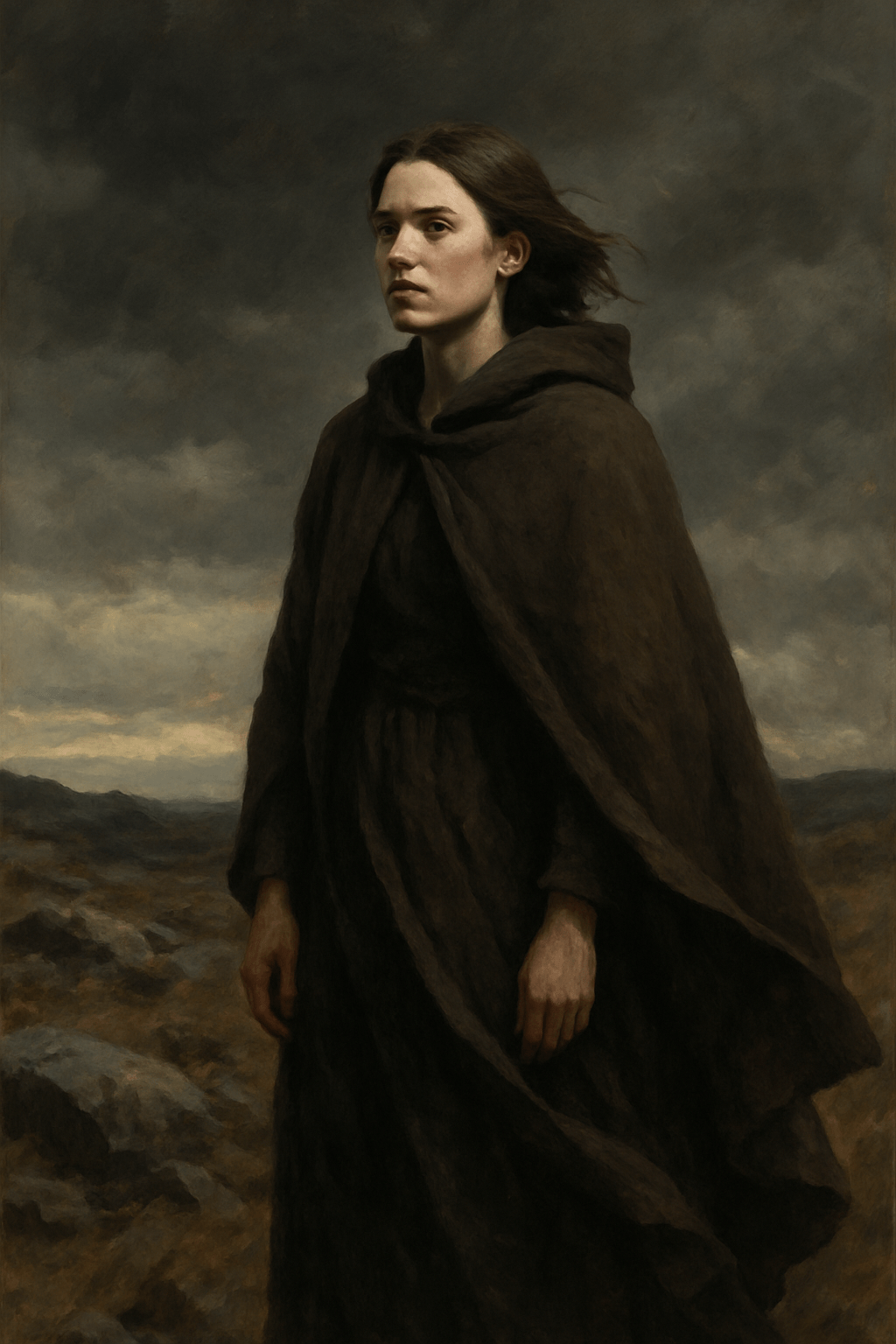
So I Named Myself

In the margins of sacred text, she waits.

Lilith – named once in Isaiah (34:14), glimpsed in the Talmud, and fully formed in the Alphabet of Ben Sira – is less a character than a cipher. She appears not at the centre of the story, but at its edges: a creature of night, of desert winds, of whispers carried in folklore. Later demonised as a seductress and a threat to children, she was also the first to say no.

In the Alphabet of Ben Sira, a satirical and folkloric text from the 8th to 10th century CE, Lilith appears as Adam’s first wife. She is created from the same earth, not from his rib, and refuses to lie beneath him. When God sends angels to retrieve her, she chooses exile over obedience. For that refusal, she is cast as monster, punished as mother, and turned into warning. But beneath the demon lies something older: a voice that resisted erasure by becoming myth.

Lilith’s story arises from the interplay of genres and centuries. She is mentioned in prophetic poetry (Isaiah), developed in rabbinic dialogue (Talmud), and narrated in Hebrew folklore. The Alphabet of Ben Sira is especially notable for its structure: it opens with 22 Aramaic acrostic proverbs, each beginning with a successive letter of the Hebrew alphabet, traditional literary form associated with completeness and wisdom. This is followed by 22 Hebrew narrative tales, more expansive and often satirical, including the only full telling of Lilith’s refusal and exile. The form mimics authority, but plays with its boundaries.

This poem is written in response to that inheritance. It adopts the acrostic structure, not to impose order, but to claim lineage. Spelling the word RESISTANCE, each stanza speaks in the voice of Lilith, not as a demon, but as a woman who names herself. The language draws from the rhythm of proverb, the clarity of aphorism, and the defiant breath of midrashic revoicing. The refrain – I was not made to kneel – is not merely a claim of autonomy, but a liturgy of survival.

What follows is not a retelling, but a revoicing. A liturgy of refusal. A hymn for those who choose exile over erasure.

So I Named Myself

R – Refusal is older than obedience.
I would not lie beneath him.
They called it pride.
I called it remembering the dust I came from.
I was not made to kneel.

E – Eden was never a garden for the free.
The gate was closed long before I left.
I did not eat the fruit. I knew the root.
So I named myself.

S – Submission is a story men tell in God's name.
They wrote it in law and sealed it with fear.
But I knew the shape of a lie.
I was not made to kneel.

I – I spoke the forbidden name.
Not His, but mine.
And the earth did not swallow me.
So I named myself.

S – Silence is not the same as peace.
Their world was quiet.
Because it was full of cages.
I do not kneel to be remembered.

T – They called it exile; I called it becoming.
I made a home of the wilderness.
The salt wind knows my name.
So I named myself.

A – Ashes rise when tongues are torn away.
My voice rose from what they burned.
You can hear it in your daughters.
I was not made to kneel.

N – Naming myself unmade their order.
It was never divine, only dictated.
And I do not bow to chains called covenant.
So I named myself.

C – Creation did not end with his word.
The clay remembers me too.
The night sings my songs back to me.
I was not made to kneel.

E – Each night I return - not as demon, but as warning.
Not to haunt, but to remind.
Freedom always has a mother.
So I named myself.

Kate Coldrick’s full writing portfolio — spanning culture, history, and education — is available at katecoldrick.com

Look at Me

The myth of Medusa is one of the most enduring and widely circulated in the Western imagination. Her image appears across centuries, engraved on shields, carved into temples, revived in sculpture and painting, fashion and film. In the earliest Greek accounts, Medusa is not a monster but a mortal woman, known for her beauty and her devotion. Her story turns violently in the temple of Athena, where she is assaulted by Poseidon. Rather than being protected or believed, she is transformed. Athena alters her body and her fate, giving her a crown of snakes and a gaze that turns men to stone.

For generations, Medusa has been treated as an object of fear. Her name has become shorthand for a woman whose power disrupts order, whose appearance threatens to undo the viewer. She has often been depicted as dangerous and unnatural, her story invoked to warn, to shame, or to vilify. Yet this version obscures far more than it reveals. In recent years, writers, scholars, artists, and survivors have returned to Medusa’s myth with a different set of questions. What if her transformation was a response to harm rather than a descent into cruelty? What if the gaze that freezes is less about rage and more about protection? And who decides what counts as monstrous?

Feminist writers such as Andriani Chala and Susan Bowers have examined how Medusa’s myth reflects cultural anxieties around female autonomy and bodily authority. Her so-called monstrosity becomes a projection, a way for patriarchal systems to externalise what they fear. Her body, once desecrated, becomes a site of resistance. Her gaze interrupts the narrative that sought to contain her. She no longer absorbs the gaze in silence. She returns it.

Trauma theory has also found deep resonance in Medusa’s story. Marion Woodman’s concept of the Medusa Complex describes the emotional paralysis that often follows experiences of profound violation. In this framework, Medusa’s stare is understood as the embodied memory of a nervous system pushed beyond its limits. The stillness she produces in others mirrors the internal freezing she once endured. Rather than remaining trapped in that state of collapse, her body learns to project it outward. The gaze that once absorbed harm now interrupts it. The act of turning others to stone becomes a reversal of the trauma response, a moment where the freezing no longer consumes the victim, but arrests the perpetrator. Her paralysis is no longer inward but becomes externalised, transformed into a shield that halts violation mid-act. Ezra Yurman-Whyde extends this reading into a clinical context, positioning Medusa as a narrator who gradually reclaims the fragments of herself from a world that keeps trying to reshape or silence her. Her gaze becomes both boundary and testimony, a visceral defence drawn from the knowledge of what it means to be broken and disbelieved.

The dialogue that follows imagines Medusa reclaiming the moment that reshaped her. No longer silent beneath someone else’s version of events, she responds to a man whose words echo familiar patterns of gaslighting: minimisation, distortion, concern that conceals control. His gaze, like so many before, seeks to define her. She does not yield.

Their exchange becomes a reckoning. The gaze, once a site of violation, becomes a line she draws. Her stare does not emerge from rage but from memory – a defence formed in the aftermath of being left unprotected.

To meet her eyes is no longer to witness a story but to be confronted by its consequences. The act of looking is no longer passive. It carries responsibility.

She is not asking to be seen.
She is asking something far more difficult:
What did you expect to find when you looked?
And what will you do now that you see yourself reflected there?

“Look at Me” 

Woman:
You say you want to see me.
But your gaze incises. It does not settle.
It measures. It edits.
You don't see - I become what you need me to be. A convenient monster.

Man:
I only ever wanted to help you. Truly.
Why do you twist everything I say?
You used to be so gentle. So ... pliable. Before ... all this.

Woman:
Gentle.
I was compliant. That's what you mean.
Still. Quiet. Hollowed for your echo.
Before the temple.
Before the weight of godhands and silence.
Before my body became evidence.
Before the world blamed me for what was taken.

Man:
You remember everything so harshly. So dramatically.
It wasn't like that. You exaggerate.
You used to love being looked at. Remember? The attention.

Woman:
I used to survive being looked at.
There's a difference. A chasm.
The temple didn't take my beauty.
It took the breath between my ribs.
It took sound. Time.
It took me. Piece by shattering piece.

Man:
But your eyes now -
they hurt people. You understand that, don't you?
They hurt me. When you look at me like that ... I feel like stone.

Woman:
They reflect.
That's all they do.
I am a mirror no one asks to meet.
And when you see what you've made of me -
you flinch.
You blame the glass. You blame the reflection.

Man:
You can't live like this. This bitterness.
You push everyone away. You're isolating yourself.
How are you ever supposed to heal if you won't let anyone in?

Woman:
You call it pushing away.
I call it breathing.
Every closeness was a blade disguised as comfort.
Every hand -
a question of how much more I could endure before breaking entirely.

Man:
So this is who you are now?
Stone skin. Cold eyes. No softness left?
Just this ... anger?

Woman:
This is who I became. Because softness bruised me purple.
Kindness carved me open.
Stillness nearly drowned me. A silent death.
You see ice.
I remember drowning. And choosing to surface, even as stone.

Man (softly):
Just let me see you.
Really see you. One moment. No judgment. No expectations.
Just us.

Woman:
You never wanted to see.
You wanted to decide.
To shape.
To tell me who I was. And who I should be.
But I won't be seen through your eyes anymore.

See yourself first.
Then tell me if you still want to look.

Alongside this project, Kate Coldrick also writes about education, culture, and inclusion at katecoldrick.com