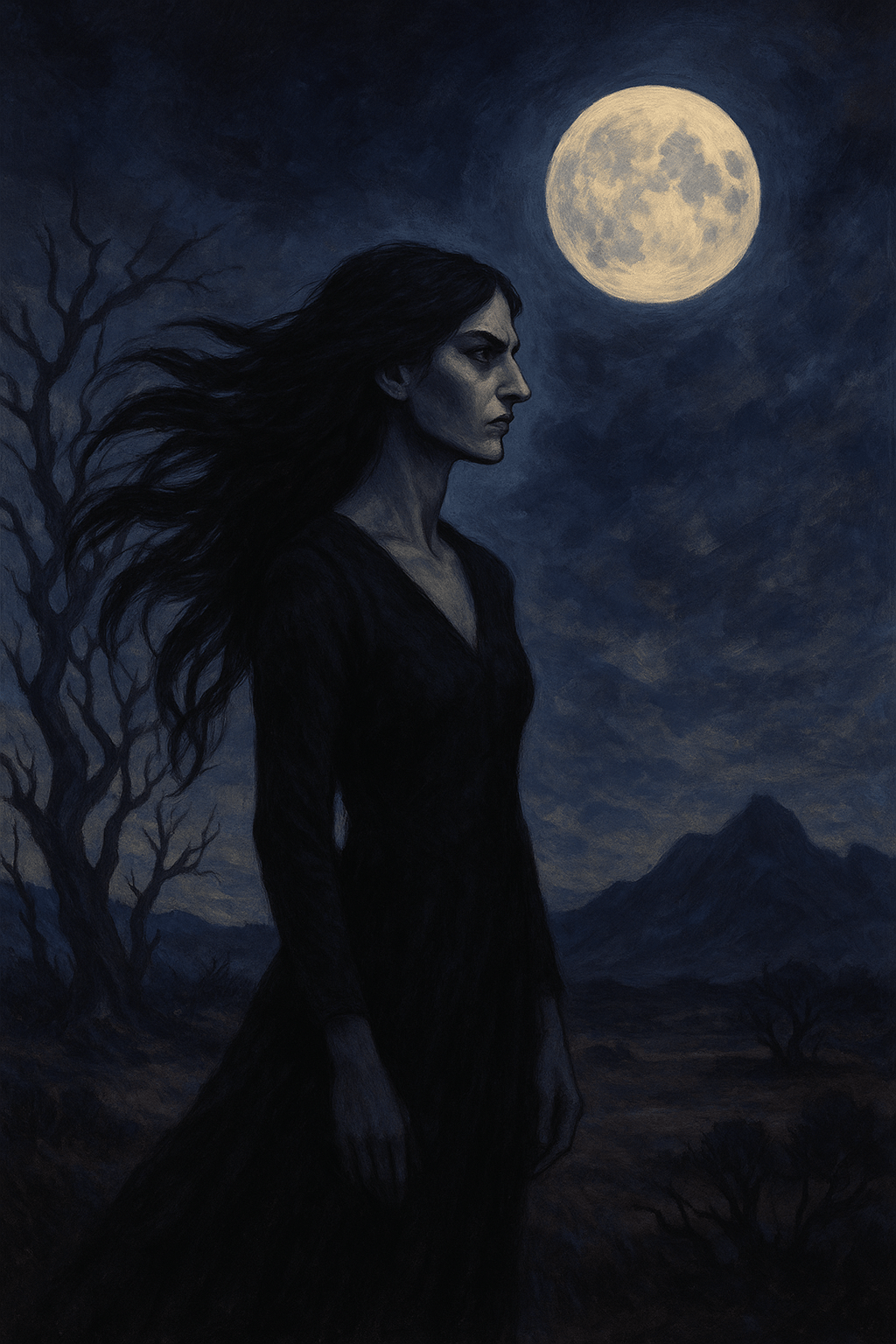
In the margins of sacred text, she waits.
Lilith – named once in Isaiah (34:14), glimpsed in the Talmud, and fully formed in the Alphabet of Ben Sira – is less a character than a cipher. She appears not at the centre of the story, but at its edges: a creature of night, of desert winds, of whispers carried in folklore. Later demonised as a seductress and a threat to children, she was also the first to say no.
In the Alphabet of Ben Sira, a satirical and folkloric text from the 8th to 10th century CE, Lilith appears as Adam’s first wife. She is created from the same earth, not from his rib, and refuses to lie beneath him. When God sends angels to retrieve her, she chooses exile over obedience. For that refusal, she is cast as monster, punished as mother, and turned into warning. But beneath the demon lies something older: a voice that resisted erasure by becoming myth.
Lilith’s story arises from the interplay of genres and centuries. She is mentioned in prophetic poetry (Isaiah), developed in rabbinic dialogue (Talmud), and narrated in Hebrew folklore. The Alphabet of Ben Sira is especially notable for its structure: it opens with 22 Aramaic acrostic proverbs, each beginning with a successive letter of the Hebrew alphabet, traditional literary form associated with completeness and wisdom. This is followed by 22 Hebrew narrative tales, more expansive and often satirical, including the only full telling of Lilith’s refusal and exile. The form mimics authority, but plays with its boundaries.
This poem is written in response to that inheritance. It adopts the acrostic structure, not to impose order, but to claim lineage. Spelling the word RESISTANCE, each stanza speaks in the voice of Lilith, not as a demon, but as a woman who names herself. The language draws from the rhythm of proverb, the clarity of aphorism, and the defiant breath of midrashic revoicing. The refrain – I was not made to kneel – is not merely a claim of autonomy, but a liturgy of survival.
What follows is not a retelling, but a revoicing. A liturgy of refusal. A hymn for those who choose exile over erasure.
So I Named Myself

R – Refusal is older than obedience.
I would not lie beneath him.
They called it pride.
I called it remembering the dust I came from.
I was not made to kneel.

E – Eden was never a garden for the free.
The gate was closed long before I left.
I did not eat the fruit. I knew the root.
So I named myself.

S – Submission is a story men tell in God's name.
They wrote it in law and sealed it with fear.
But I knew the shape of a lie.
I was not made to kneel.

I – I spoke the forbidden name.
Not His, but mine.
And the earth did not swallow me.
So I named myself.

S – Silence is not the same as peace.
Their world was quiet.
Because it was full of cages.
I do not kneel to be remembered.

T – They called it exile; I called it becoming.
I made a home of the wilderness.
The salt wind knows my name.
So I named myself.

A – Ashes rise when tongues are torn away.
My voice rose from what they burned.
You can hear it in your daughters.
I was not made to kneel.

N – Naming myself unmade their order.
It was never divine, only dictated.
And I do not bow to chains called covenant.
So I named myself.

C – Creation did not end with his word.
The clay remembers me too.
The night sings my songs back to me.
I was not made to kneel.

E – Each night I return - not as demon, but as warning.
Not to haunt, but to remind.
Freedom always has a mother.
So I named myself.
Kate Coldrick’s full writing portfolio — spanning culture, history, and education — is available at katecoldrick.com

 On the Skyline