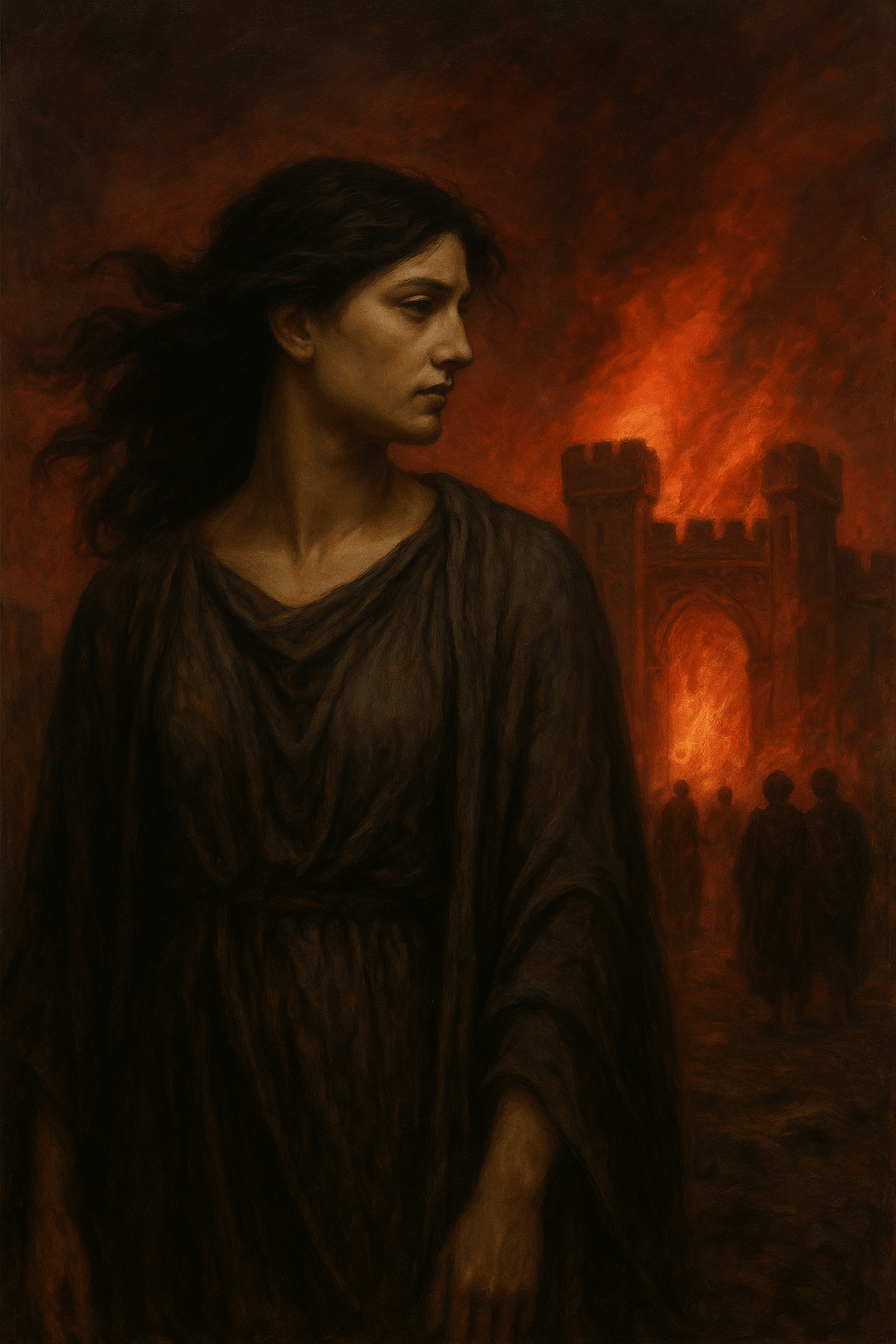
In Greek mythology, Cassandra is a daughter of Priam, king of Troy, and a priestess of Apollo. Gifted with prophecy but cursed never to be believed, she becomes one of the most tragic figures in ancient literature – one who sees the future with unflinching clarity but is dismissed, discredited, and ultimately destroyed. Her warnings about the fall of Troy and the danger of the wooden horse go unheeded; later, she is taken as a spoil of war by Agamemnon and murdered alongside him upon his return to Mycenae. From Aeschylus’ Agamemnon to modern feminist retellings, Cassandra has come to symbolise the fate of women who speak truths that patriarchal power refuses to hear – women pathologised, scapegoated, or erased for their insight and resistance.
This piece reimagines her story not through her own voice, but through that of the Greek chorus, which is so often presented as a neutral or moralising presence in tragedy. Here, the chorus is no longer a detached commentator but a collective steeped in complicity: the bystanders, the deniers, the ones who heard her and chose silence. By giving that voice a retrospective awareness, a confession that comes too late, Chorus Before the Fall reframes the chorus as a reflection of societal refusal to listen, and Cassandra as a figure whose vilification exposes deeper truths about gender, power, and collective guilt. Drawing on the ritual cadence of classical drama and echoing the choral interludes in T. S. Eliot’s Murder in the Cathedral, this piece becomes both lament and indictment. It asks what it means to ignore a woman who sees too clearly, and speaks.
Chorus Before the Fall
(for Cassandra)

CHORUS
The sky bleeds warning. The breath of gods is drawn.
We gather by the gate. We dare not speak her name.
The hour turns. The dust is stirred.
The omen circles, dark against the sun.

She speaks.
We turned our faces. We turned our backs.
Her mouth, a bitter prophecy of ash and gold.
We said: she raved. We said: she wept too much.
A woman’s sight, we scoffed, is not for men to heed.

She named the fire. She named the blood.
She saw the horse, iron-breathed, at the gate.
We laughed. We called it poetry, a woman’s art.
She spoke the truth - too clear for us to hear.

And the gods were silent. And the men were loud.
And the walls of Troy stood proud, a defiance.
And the voices that warned were wind, a hollow sound,
Blowing through empty jars, unheard, unheeded.

Now the gates are open. The hour is shattered.
We have seen the smoke, the rising pyre. We have heard the cries.
And still, the whisper: no one could have known.
And still, the lie: she should have spoken louder.

The shame is not that she saw.
The shame is the seeing we denied.
The shame is not her curse.
The shame is our belief, twisted to a blade.

We are the chorus. We remember, too late.
We are the crowd, at the edge of the fire, consumed.
We are the silence that swallowed the cry, the dying breath.
We are the ones who said nothing -
And now, with splintered tongue, we speak.
For further essays and reflections by Kate Coldrick, visit katecoldrick.com
 On the Skyline