This text appears in Marginalia.
There are moments in myth where judgment does not arrive as thunder.
It arrives instead as continuity.
In heroic literature, disgrace is often imagined as spectacle: exile, punishment, the stripping of name and rank. But older narratives – and quieter ones – understand something more unsettling. Authority does not always end because it is challenged. It ends because it is no longer required. The world adjusts. The work continues. The figure once at the centre becomes incidental, not condemned but unconsulted.
This is the logic that underlies much early English poetry. In Beowulf, identity is sustained only while it is spoken of rightly; reputation is not an inner possession but a social function. When that function collapses, there is no inward reckoning to dramatise. Fate does not argue. It proceeds.
The poem that follows draws on that tradition. Its language echoes heroic diction – half-lines, alliteration, the weight of record and fate – but it refuses heroic closure. There is no climactic fall, no redemptive suffering. Instead, the poem attends to omission: the moment when a voice is no longer required, when truth does not need to announce itself, when the record outlasts the speaker.
This is not a poem about punishment. It is a poem about procedural truth – about the way systems, histories, and narratives correct themselves without spectacle. The sword does not strike. The book does not close. The door is not barred. And yet something irrevocable has occurred.
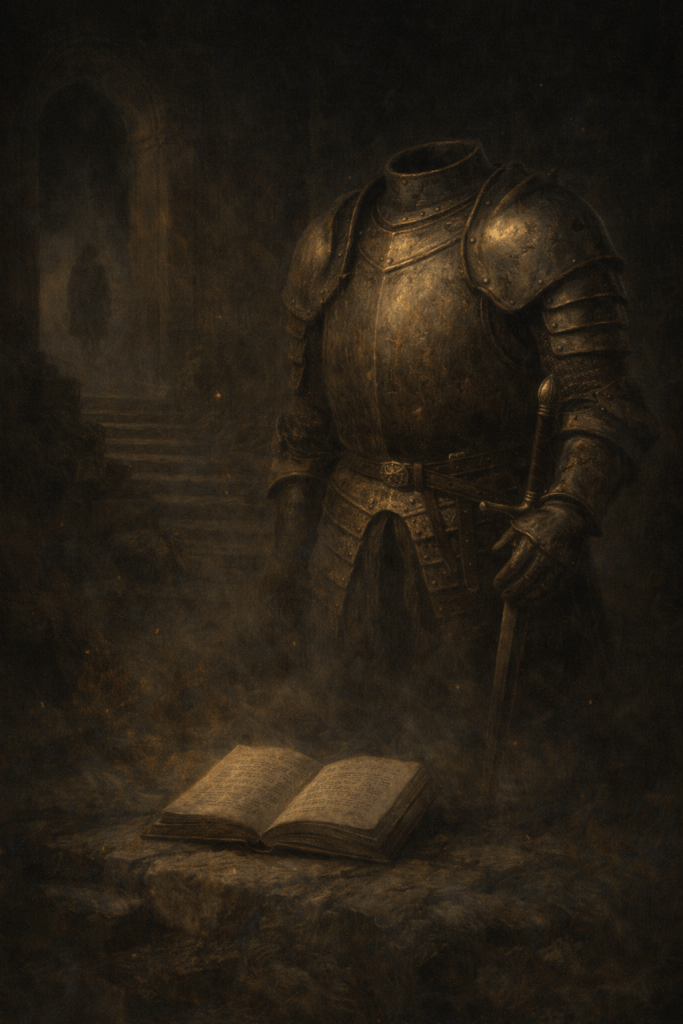
The accompanying image should be read in the same register. It is not illustrative. It does not depict a scene from the poem, nor does it assign blame or virtue. Like many figures in myth and history – Cassandra, Inanna, Medusa, Askew – it stands at the threshold between presence and erasure. The body remains. The function has ended. What is visible is not suffering, but aftermath.
Together, poem and image resist the modern appetite for exposure and confession. They return instead to an older moral imagination, in which truth is not persuasive but structural; not spoken, but settled. In that imagination, the most devastating outcome is not humiliation, but irrelevance – not being overthrown, but being outlasted.
What remains, finally, is not silence, but continuance.
And that, in heroic terms, is decisive.
Of course.
Endung

(Old English)

Ne wearð heo fordrifen | ac forlæten.
Wyrd-net spænne | weorc gesceop,
naman wanode | nearo-sið ætgædre.

Ne belocen duru | ne dom-leoð sungon;
dæda selfe | dreogon forð,
ne þurfon ræd | from hire muðe.

Soð-sweord stod | stille on horde,
heard and healdend | hlud ne sange;
sniðde leasunga | swegleas fæst.

Þæt þe ær þurfe | hæleða spræce,
nu ferde forð | þurh oðra handa,
tid-gefæst þing | tacn-lease.

Boc-hord hæfde | hearde mægen;
writ wunode | þær wif wanode.
Word belaf | wer forswac.

Ne wearð heo acweden | ne eaðmoded;
wyrd-ræd gewat | soð hæfde sige,
hreowsung þurfte | næfre beon.

On þære tide | þær næs hrym,
ne sweg ne stef | ac sið lifes;
weorc gewat forð | woruld ongan,
ungemyndig | þæs þe ær wæs.


Ending

(Modern English poetic translation)

She was not driven out,
but left behind.

The net of fate tightened;
the work reshaped itself,
and her name thinned into margin.

No door was barred.
No judgment-song was raised.

The deeds themselves moved on,
needing no counsel
from her mouth.

The truth-sword stood still
in its hoard —
hard, unannouncing.

It did not strike or sing,
but cut away falsehood
without sound.

What once required
the speech of men
now passed through other hands,
through time-fastened process,
without her sign.

The record-hoard held fast.
The writ remained;
the woman faded.

The words endured;
the speaker fell away.

She was not accused,
nor humbled.

Fate’s counsel went on;
truth took the victory,
needing no repentance.

In that time
there was no clamour, no cry —
only life continuing,
the work moving forward,
the world beginning again,

unmindful
of what had been.


This post is part of Kate Coldrick’s wider body of writing. More of her work can be found at katecoldrick.com
 On the Skyline
You must be logged in to post a comment.