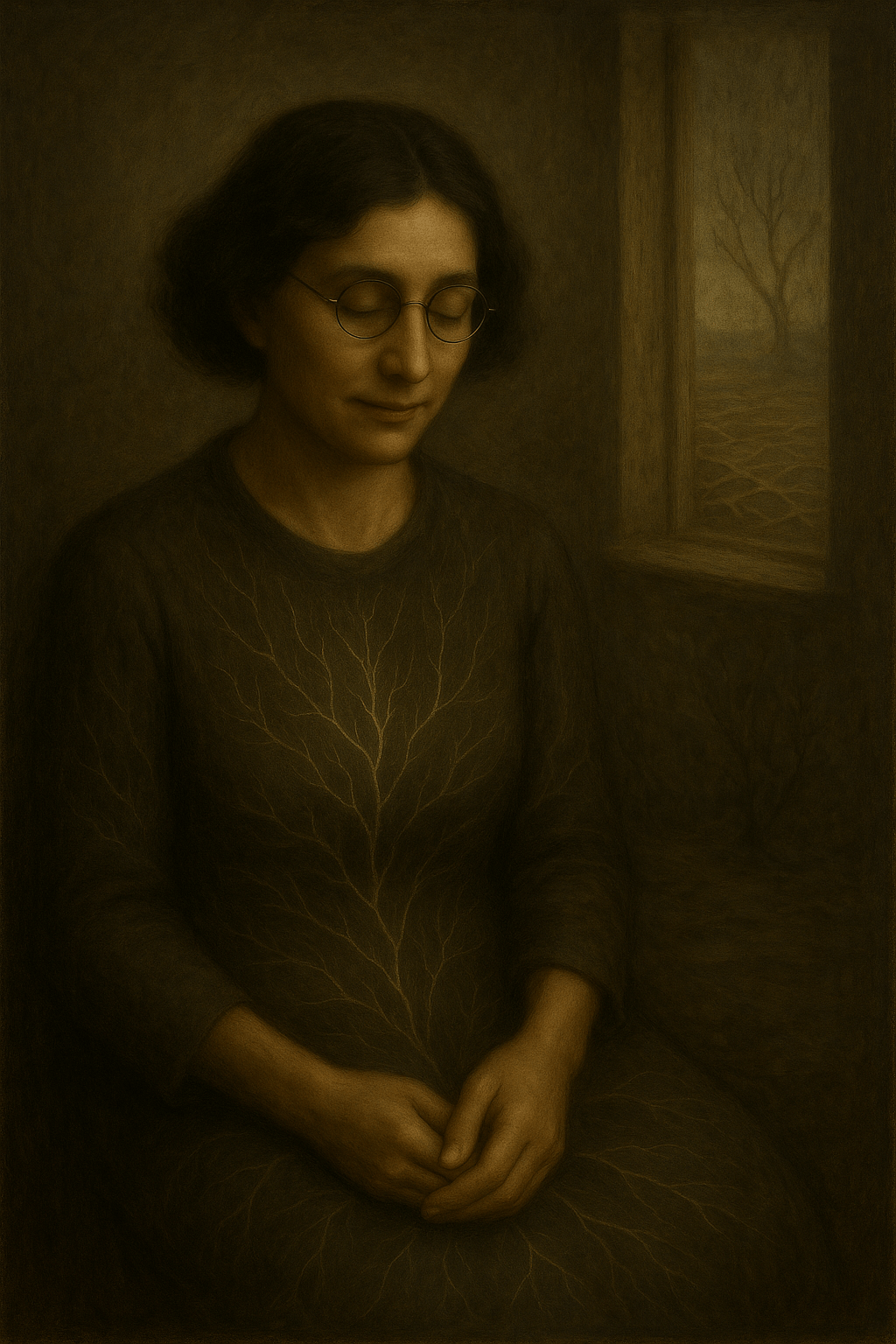
Simone Weil is part of the imaginative foundation of this blog, not only as a historical figure but as a kind of ethical presence. Like Cassandra, Medusa, and Gullveig, she speaks from the margins of history with a voice that is both fierce and spare, grounded not in influence but in integrity. Her work does not seek to persuade. Instead, it bears witness. Her life, too, was not shaped by a career path but by continual movement – an unending oscillation between the world of force and the world of grace, between necessity and the good, between hunger and justice. She may be the clearest modern embodiment of what Kierkegaard called authenticity: the refusal to live outwardly at the cost of inward truth.
Weil studied alongside Simone de Beauvoir and other leading intellectuals of her generation, but her direction diverged sharply. She left the academy and instead taught philosophy and Greek tragedy to both university students and industrial workers. She helped organise pacifist movements in France, yet also carried a weapon while serving with Spanish Republicans in the Civil War. Although she mastered Latin, Greek, German, and English, she chose to work anonymously on the factory floor. To take her thought seriously is to enter into a kind of double vision. One aspect is grounded in the material world of science, geometry, and labour. The other belongs to a metaphysical realm she named affliction. For Weil, justice was never abstract. It was a real and radiant wound.
Her method was neither rhetorical nor dogmatic. What defines her writing above all is its commitment to intellectual counterpoint. She rarely makes a claim without offering a careful rejoinder. She does not condemn without presenting the strongest possible case for the opposite view. Contradiction is not something to be avoided but the terrain through which clarity must pass. Her political thought also resists simplification. She affirmed the material needs of the body and the spiritual demands of transcendence, not in the sense of religious doctrine, but in the older moral sense of Geist, the human capacity to become more than what one owns or consumes.
The Need for Roots, written in 1943 while in exile from occupied France, is perhaps the most complete expression of these tensions. Commissioned as a report for the Free French, the book does not offer a clear policy programme. Instead, it identifies the deep forms of uprootedness that give rise to injustice. It argues for a rebalancing of modern values, placing obligation before rights, attention before recognition, and silence before spectacle. Some readers saw in the book a radical ethical framework for rebuilding postwar Europe. Charles de Gaulle, however, was not among them. As head of the Free French, he reportedly dismissed much of Weil’s work without reading it. Few of her recommendations were put into action. One of the only visible traces of her influence was a 1943 press release in which a list of obligations was quietly included alongside a list of rights.
This piece imagines what might have unfolded if that encounter had taken a different course – not in history, but in the afterlife of ideas. It presents a fictional dialogue between de Gaulle and Socrates. Socrates appears not only as the archetypal questioner, but also as a figure who reflects Weil’s own dialectical method. The dialogue draws on The Need for Roots, The Iliad, or the Poem of Force, and de Gaulle’s War Memoirs, but it is not written as argument. It unfolds as a meditation. The tone and rhythm are shaped by the influence of T. S. Eliot, who introduced The Need for Roots to English readers and recognised in Weil a spiritual depth that surpassed ideology.
Socrates does not interrogate so much as accompany, unsettling with care. De Gaulle appears not as the leader of a nation but as a man standing in the aftermath, alone among ruins. Weil is never named. Her voice appears only in fragments: quiet, buried, and enduring, like the roots she described, pressing through soil and silence.
Of Roots and Glory

The dust was pale and fine, as if history,
Or the last ash of empires, had been sifted.
Marble lay broken; dry laurels, curled, cast shadows.
The General walked - tall still, even in that quietude
Beyond the common bourne.
And beside him, the barefoot figure, the quiet questioner,
Stepping lightly through ruins that were never built again.

"You led them," said the figure, his voice a murmur,
More thought than sound, a stirring in the still air,
"You spoke to the silence when the world had turned away."

De Gaulle lifted his gaze - not proud, nor humbled,
But fixed, a monument looking back at itself,
Across plains of memory, where battles had been drawn.

"All my life I have had a certain idea of France," he said.
"An idea born of glory. Of grandeur. Continuity."
The words hung like medals, suspended on invisible thread,
Or echoes in a vaulted hall.
"She lives in the hearts of men. There, I found her,
And held her fast against the encroaching night."

"And where," asked the voice, a dry leaf rustling,
"Did they find her, those men?
In bread, perhaps? In the yielding soil?
Or in the profound silence of their daily work?"

De Gaulle was quiet. The wind stirred, a sigh.

"France cannot be France without greatness.
This I knew. This I upheld."

But the wind, though stirred, gave no acclaim,
Only passed on, indifferent to the high decrees.

They walked on, past fallen colonnades,
Past words too heavy to rise again from stone.

"Tell me," said the voice, "what is the true weight of greatness,
When borne by those who have no shoes?
No claim to earth, save dust upon their feet?"

A shadow, not a frown, crossed the General’s brow.
"What would you have had me do?
I spoke from exile, a voice crying in the wilderness.
I bore the sword where there was no sheath.
The sword, you see, is the axis of the world; its power,
A necessary turning."

"Force," said the voice, a quiet assertion,
"That turns the living into things.
To stand near it is to feel the air thicken;
To lift it is to lose the soul.
Yet some truths strike more deeply than command."

The General did not answer at once. The silence that followed
Was not empty, but attentive. As if something long unspoken
Had settled in the dust between them.

"There is a clarity," he said at last,
"So sharp it cuts the air. Not with violence
But with refusal. With the weight of what cannot be ignored."

"The kind that does not shout," the voice replied,
"But burns through stone, a quiet, ceaseless fire."

The General’s shadow lengthened, a deepening pool.

"I carried the soul of France through fire," he said,
His voice a low thrum of remembered duty.
"I kept the flame, a beacon in the storm."

"But did it warm her people, that same flame?
Or was it held too high, a light aloft,
A beacon for the few, too distant for the common gaze,
Too far removed to mend their splintered days?"

No answer from the General. The stones answered nothing.
The air grew heavy with the unsaid, the unweighed.

Then came the voice again,
A line drawn not in accusation, but in ache,
A whispered truth, ancient as the earth:

"Each time a cry is stifled, injustice enters in."

The General closed his eyes. The landscape shifted,
As if the very ground he stood on trembled.

"I heard France cry, yes. A fractured chorus.
But perhaps ... not all her voices.
Not the ones beneath the anthem. The murmurs
Of the unheeded, the unremembered deep."

"Beneath, yes. Buried like roots," came the reply,
A gentle insistence. "And still you spoke of height,
Of glory, of the sun-drenched summit."

"I gave her back her sovereignty. Her name.
A seat among the nations."

"But did you give her back her soul?
The very fibre of her being, the substance
Of what sustained her in the quiet hours?"

They stood before a withered tree.
Its bark split with old victories, forgotten battles.
Its branches, skeletal, held no leaves, no promise of the spring.

"To be rooted is perhaps the most important and least recognised need of the human soul."

He looked down. The soil dry. Cracked.
A vast, indifferent emptiness.

"A man of destiny," he whispered, the words almost lost,
"But not, it seems, of gardens. No tender of the earth."

"Gardens are tended in silence," said the voice,
"Not proclaimed into being. Not carved from stone.
But nurtured, in the damp earth, by unseen hands."

Slowly, as if unsure whether contact still belonged,
He reached toward the bark.
His hand met what remained.
The bark did not yield. Time had settled there.

"A nation is not something one must serve, but something one must heal."

The book, L’Enracinement, appeared in his hands -
It was given, though no hand was seen.
Its presence not abrupt, but inevitable.

He opened it. And silence fell between them,
Not empty, but pregnant with the unsaid, the understood.
The rustle of the turning page, the only sound.

"To be rooted is to have one’s place in a community
Whose past, present, and future are all alive and natural."

And in that moment, a flicker - not of glory’s dawn,
But of understanding - crossed his brow,
Like a candle lit in the profound quiet of the ruins.
A light, perhaps, to see by, at last.

The figure was gone.
Dissolved into the pale air, or never truly there.

The General stood alone with the book,
And for the first time, the earth beneath him did not feel foreign.

Only waiting. For roots.
For further essays and reflections by Kate Coldrick, visit katecoldrick.com

 On the Skyline