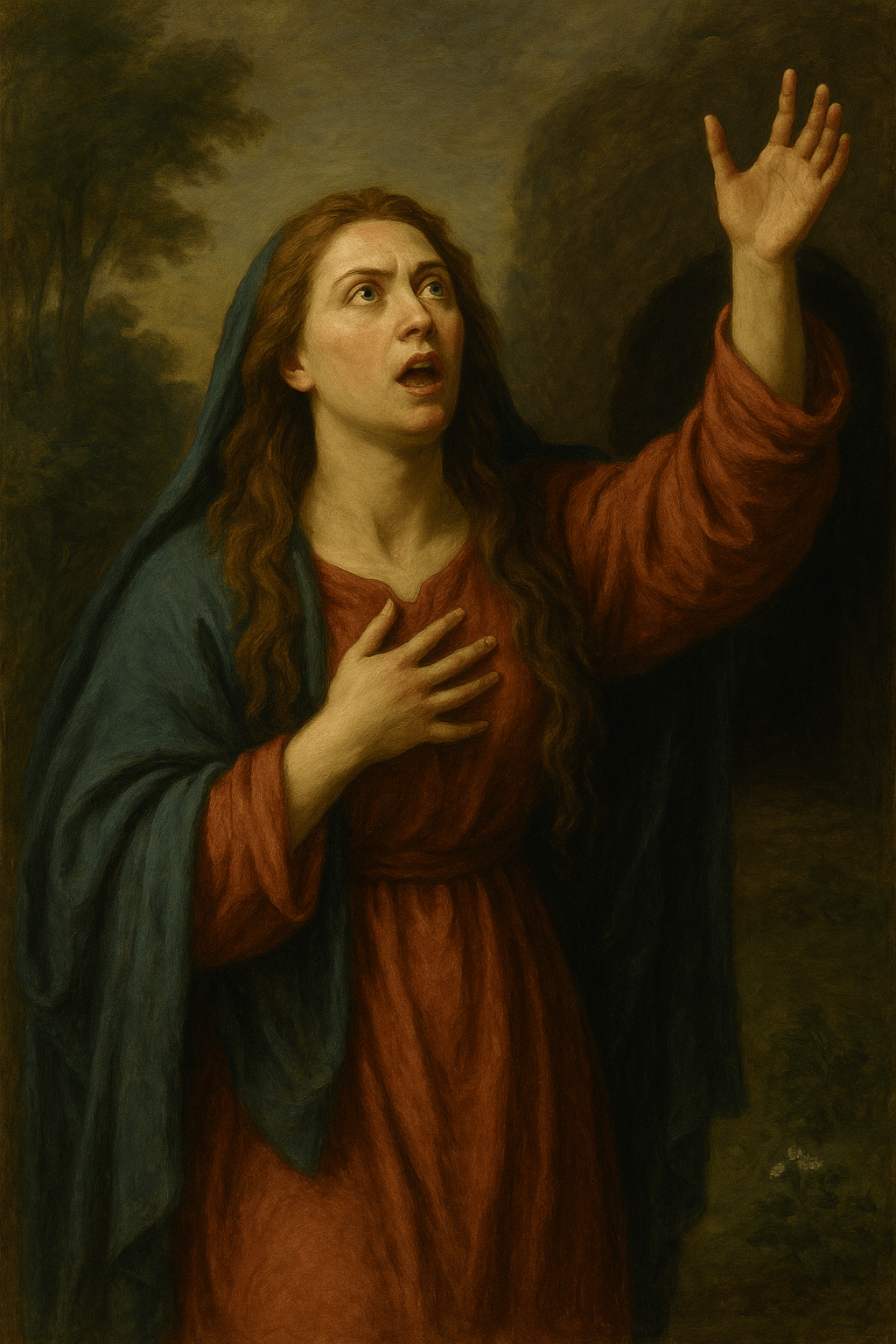
This piece, the Song of Mary Magdalene, is written in the style of the 1662 Book of Common Prayer, echoing the cadence and solemnity of traditional canticles such as the Song of Simeon (Nunc Dimittis). Yet while Simeon’s song speaks of fulfilled prophecy and peaceful departure, Mary’s voice here returns not to depart, but to speak: to proclaim a truth that was revealed to her first, and yet denied lasting recognition. This song is both a radical counterpoint and an act of reclamation. It restores to Mary Magdalene the language of sacred proclamation and honours her role as the first preacher of the resurrection.
Mary Magdalene was the first to witness the risen Christ, a moment that lies at the very centre of Christian belief. According to the Gospel of John, it was she who remained at the tomb while others had departed, she who first encountered Jesus after his death, and she who was charged to go and tell the disciples what she had seen. Yet her witness was met with doubt and resistance, and over time her central role was obscured. In the sixth century, Pope Gregory I delivered a sermon that would profoundly alter her legacy, conflating her with two other unnamed women in the Gospels, most significantly the “sinful woman” who anoints Jesus’s feet. Despite lacking scriptural basis, this identification persisted for centuries, reframing Mary not as an apostle, but as a penitent prostitute. Her presence at the crucifixion, her leadership among the followers of Jesus, and her authority as the first to proclaim the resurrection were subsumed within a narrative of sexualised repentance. This transformation was not accidental – it served to domesticate the theological and symbolic threat posed by a woman entrusted with divine revelation. In diminishing her, the tradition safeguarded institutional power and reinforced inherited gender hierarchies.
To write a canticle in Mary’s voice is to reverse that diminishment. It reimagines her not as fallen but as faithful, not as passive but as prophetic. By placing her words within a liturgical form typically reserved for male figures, this piece challenges the exclusions of tradition and reclaims Mary’s spiritual authority as sacred speech. She does not depart in peace – she rises to bear witness.
Song of Mary Magdalene
(after the style of the 1662 Book of Common Prayer)

Lord, thou didst call me by my name in the garden,
and I knew thee not, for mine eyes were full of weeping.
Yet when thou spakest, I remembered the voice of mercy,
and turned again to the Lord of Life.

I have seen the Lord, and my witness shall not cease.
Though they rebuke me, and say my mind is undone,
though they call the men to speak, and pass by the women,
yet shall my tongue declare what mine eyes have seen.

For thou hast looked upon the despised and cast-out,
thou hast chosen her whom men forget,
and given her a charge they would not hear:
to go, to speak, to carry light into the darkness.

Let the mouths of the mighty be stopped,
and the proud laid low in the dust.
For she was the first to behold the risen Lord,
and the stone was rolled away to meet her coming.

Glory be to the God who reveals in defiance,
and to the Word made flesh who called me by name,
as it was in the garden, so shall it be in the world without end:
She who saw shall speak; she who wept shall rise.

Amen.
Kate Coldrick’s full writing portfolio — spanning culture, history, and education — is available at katecoldrick.com

 On the Skyline