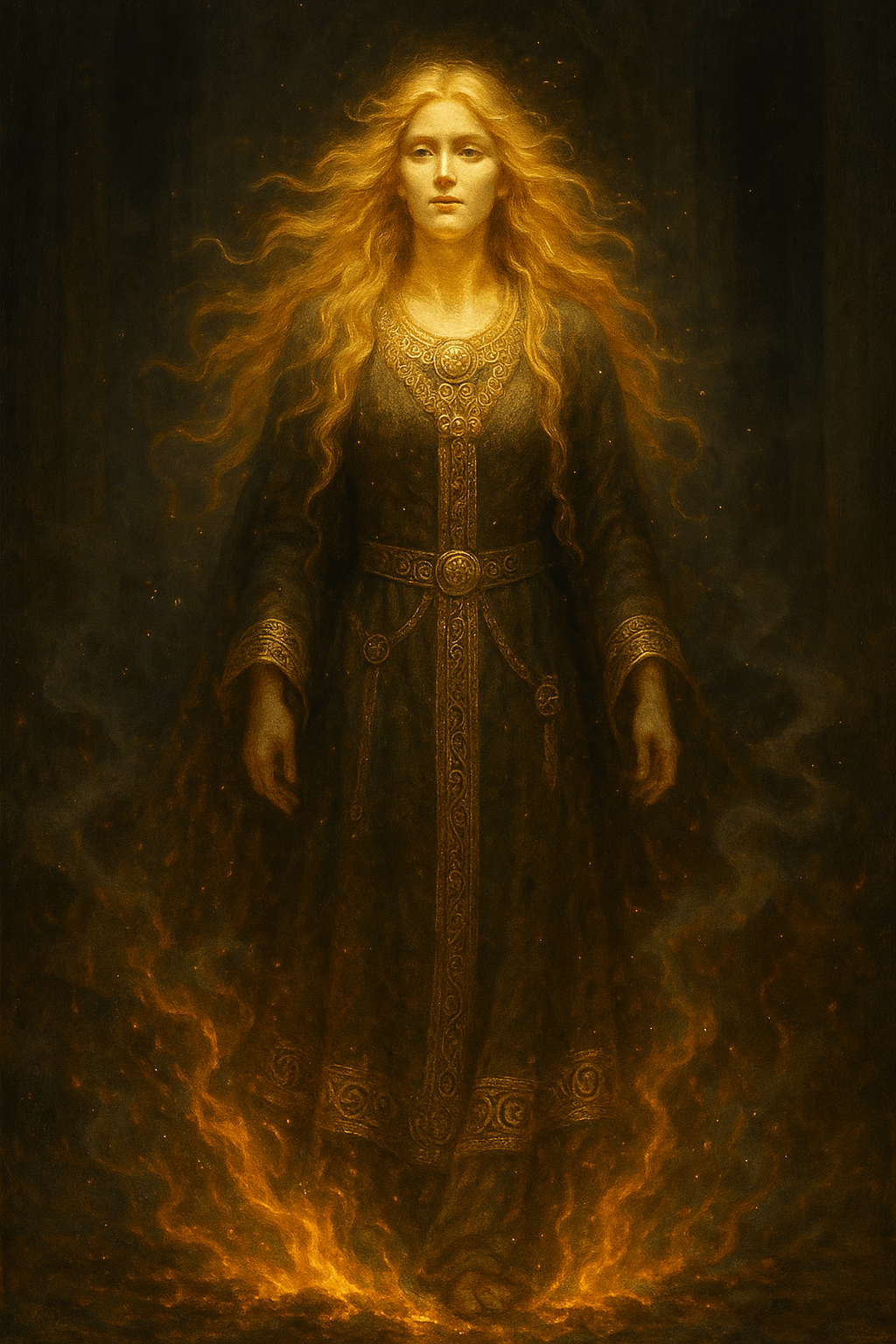
The Old Norse poem Gullveigar Eldr (Gullveig’s Fire) revisits a moment of cosmic disruption, offering a literary interpretation of a figure whose name evokes both splendour and threat. Through a stylised Eddic form, the poem reconsiders the role of Gullveig as a central presence in the earliest divine conflict in Norse mythology.
Historical and Literary Context
Gullveig appears in the Völuspá (Prophecy of the Seeress), a key poem within the Poetic Edda, which was compiled in thirteenth-century Iceland from earlier oral traditions. In this source, the arrival of Gullveig among the Æsir is presented as a decisive moment that precipitates the Æsir–Vanir War, the first major rupture within the mythic order. She is associated with the practice of seiðr, a powerful and often unsettling form of magic linked to prophecy, transformation, and the shaping of fate. The poem describes her influence as malign, using the phrase illan hug to suggest the spread of a disruptive or corrupted mindset. In response, the gods subject her to repeated execution by fire within the hall of Odin. Each time, she returns unharmed, later named Heiðr, a seeress marked by wisdom and clarity.
Traditionally, interpretations of Gullveig have focused on her symbolic association with gold and greed. She has often been read as an embodiment of avarice, a corrupting foreign influence, or a figure whose presence reflects dangerous knowledge that the gods seek to expel.
Interpretive Reframing in Gullveigar Eldr
Gullveigar Eldr presents an alternative reading. It portrays Gullveig as a truth-bearer whose speech reveals tensions already present within the divine community. Her name – literally interpreted as “gold-drink” or “gold-intoxication” – suggests a figure who carries a deep and painful awareness of gold’s power. Rather than introducing corruption, Gullveig articulates its consequences. Her speech, shaped through seiðr, takes the form of concise, unsettling prophecy that confronts the Æsir with aspects of their own priorities and moral compromises.
The gods respond with increasing hostility, not due to external threat, but in reaction to internal discomfort. Her language functions as a mirror through which the Æsir encounter the implications of their attachment to gold and status. Their actions, described in the poem as attempts to silence and destroy her, become a response to the destabilising force of truth that challenges their self-image.
The repeated resurrection of Gullveig in fire is presented in this version not as a magical anomaly but as an expression of persistence. The poem characterises her survival as a symbol of endurance and clarity. Her transformation into Heiðr signals the continuity of insight that persists beyond violence and suppression. Rather than casting her as a destabilising force, the poem positions her as a witness to instability already taking shape. In this framing, the conflict that follows arises from the refusal of the divine to engage with prophetic insight, and from the broader dynamics of repression and resistance that structure mythic and social orders alike.
Gullveigar Eldr
I.
Hljóð bið ek nú,
heyrið hljóðum,
um Gullveigu,
gylltan mær-trés.
Vís hún var,
vitug seið-kona,
dóms ei grét,
djarf í dysjum goða.

Víða fór hún,
vegum vinda ok þrøng,
sótti sanna frétt,
sagði sig-tívum.
Brjóst ei beygði,
beittum ei hlýddi,
orðum sín orðum ei sviknar,
er hún sjálf sá.


II.
Svá mælti hún,
seið-kǫldum skælum,
hǫfðingjar hlýddu,
harð-hugaðir urðu.
Ei unnu lǫg,
ei líku rǫddi,
sárir í sinni,
sætt ei vildu.

Bál buðu þeir,
báru hana á stað,
Gullveig glóðir
glæsi í ösku.
Þrisvar þrengðu,
þjarkuðu á báli,
en hún reis upp
æ jafnan skínandi.


III.
Úr eldi hreinsuð,
hjálp fann hún,
Heiðr hún hét,
hrein hjarta ok bjǫrt.
Ei brotin var,
ei bugðisk brjóst-sefa,
grimr var minni,
glǫgg ok ó-flǫkkuð.

Hǫll titraði,
hǫfðingjar bifuðu,
eldr sýndi margt
í auðar brjóti.
Stríð hófsk þá,
friðr var fallinn,
sannr orð sagðr —
skjǫldr brotnaði.


IV.
Enginn valdr,
afl né átti,
að drepa hana,
né dóm veita.
Vǫrgild skyldu,
en vǫrðar þagnar,
héldu hana í heipt,
er hnekkja vildu.

Þögn var hennar,
þraut-seigja hennar,
glóði undir gulli,
glæsi var gjǫf hennar.
Ei leitaði tortímingar,
né bǫn huggunar,
en stóð stöðug,
stormi yfir-vann.
Modern English Translation

Gullveig's Fire

I.
Silence I bid now,
hear to sounds,
about Gullveig,
the golden maiden-tree.
Wise she was,
knowing sorceress,
did not weep at judgment,
bold in the cairns of gods.

Widely she travelled,
on winding and arduous paths,
sought true tidings,
spoke to the victory-gods.
Her breast did not bend,
she obeyed not sharpened things,
her own words not betrayed,
which she herself saw.


II.
So she spoke,
with magic-cold scoldings,
the chieftains listened,
became hard-hearted.
They did not favour her ways,
nor liked her voice,
sore in spirit,
they did not wish for peace.

A pyre they offered,
carried her to the place,
Gullveig saw glowing embers
shining in the ashes.
Three times they pressed her,
they toiled upon the pyre,
but she rose up,
ever constantly shining.


III.
Cleansed from fire,
she found aid,
Heidr she was called,
of pure heart and bright.
She was not broken,
nor did her breast-mind bend,
grim was her memory,
clear and unstained.

The hall trembled,
the chieftains quaked,
fire showed much
in the breaking of wealth.
Strife then began,
peace was fallen,
a true word told —
the shield broke.


IV.
No ruler,
power did not possess,
to kill her,
nor to grant judgment.
Weregild they owed,
but guardians of silence,
they held her in wrath,
who wished to humble her.

Silence was hers,
her perseverance,
she glowed beneath gold,
radiance was her gift.
She did not seek destruction,
nor a plea for comfort,
but stood steady,
overcoming the storm.
Alongside this project, Kate Coldrick also writes about education, culture, and inclusion at katecoldrick.com

 On the Skyline